Tag Archive for: computer vision

Adani Airports deploys its aviio platform to drive operational efficiencies

A broken baggage belt, a growing security queue or a malfunctioning toilet might seem like routine airport problems, but identifying them quickly can make the difference between a minor disruption or an escalation to a passenger complaint or dispute.

Adani Airport Holdings, which operates eight airports including Mumbai, Ahmedabad and Lucknow, is using its AI-enabled aviio platform to bring these operational issues into view, allowing staff to respond before matters get worse.

“If a baggage belt is broken, a ticket will get raised later, but the ministry will get a tweet before that!” Ekta Ghosh, Chief Digital Officer at Adani Airport Holdings, tells the Airports AI Alliance. For Ghosh, the challenge is to ensure airport teams have access to information early enough to act, rather than learning about problems through passengers or social media.

The pressure is growing as airports accommodate rising passenger demand. Boston Consulting Group is forecasting Indian air travel growth of 12 percent in 2026, compared with 5.8 percent globally.

Ekta Ghosh, Chief Digital Officer at Adani Airport Holdings

“While there is a lot of investment happening with privatisation to create more airport capacity, build more terminals and make sure there are more runways, that takes time,” Ghosh says.

So Adani has developed aviio to combine information from airport systems, airlines, security agencies and connected devices to support operational decisions and drive efficiencies. Which in turn means that its terminals can operate effectively even with the growth in passenger numbers.

Building the foundations

Integrating previously disconnected systems into avioo has been a major undertaking. Adani has identified more than 100 airport, airline, commercial and infrastructure systems for integration, including sensors and operational technology, with approximately 60 to 70 connected so far.

The platform uses APIs and integration software to exchange information in real time, supported by a common data model covering aeronautical and non-aeronautical operations. Bringing these sources together allows operational teams to work from shared information rather than separate systems.

Data governance is another priority. Adani has worked with India’s aviation authorities and other stakeholders to establish digital access procedures reflecting existing physical security arrangements. Users undergo identity verification and multi-factor authentication, while role-based controls restrict what individual organisations can see.

“I do not want IndiGo to look at Air India’s data,” Ghosh explains. “I do not want CISF [Central Industrial Security Force, which provides airport security] to look at non-aero operations data.”

The platform also works without passengers’ names or other personally identifiable information from airlines. Instead, aggregated flight manifest data enables aviio to forecast hourly passenger arrivals, helping the CISF to plan screening resources.

Forecasts of peak arrivals and the expected proportion of male and female passengers help determine how many separate pat-down lanes should be opened. Rather than waiting for queues to develop, security managers can prepare staffing levels in advance.

Encouraging collaboration

Persuading external partners to share operational information has presented another challenge.

“Airlines and airports, as we know, historically do not share data,” Ghosh says. “So we’ve started the conversations by describing what’s in it for them?”

Adani is focusing on demonstrating practical benefits. Computer vision can identify queues building at check-in counters, helping airlines assess staffing needs and respond to congestion. Two Indian airlines are testing customised dashboards, which Adani is providing to operational partners free of subscription charges.
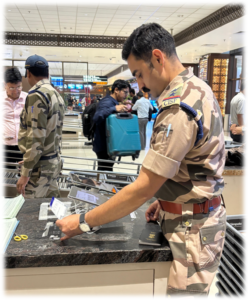
The CISF has also received mobile phones and tablets preloaded with aviio. One application digitises the recording of prohibited items discovered during security screening. Instead of photographing confiscated objects and separately writing down their details and the passenger’s boarding pass information, officers can capture and upload the records using computer vision.

These applications illustrate how data-sharing arrangements translate into operational benefits. They also give airlines and security agencies a practical reason to participate in a platform managed by an airport operator.

Changing established working practices

Mumbai was the first airport to deploy aviio, but changing employee behaviour proved difficult. Terminal staff accustomed to telephoning the Airport Operations Control Centre continued doing so even after the same information became available on their mobile devices.

Adani introduced training and hands-on support, but Ghosh says “what really worked was that we started shutting down the alternative systems”.

Approximately 15 standard operating procedures have been digitised, covering activities such as incident reporting, foreign object detection and security screening. Older email-based and ticketing processes have progressively been decommissioned, making aviio part of routine operations rather than an optional add-on.

Adani has also introduced leaderboards comparing adoption across its eight airports. Daily operational reviews now take place through the platform, while senior executives are beginning to use it for monthly financial and non-aeronautical reviews.

“If your leader is looking at it, adoption gets to 100 percent,” Ghosh comments.
Measuring results and improving accuracy

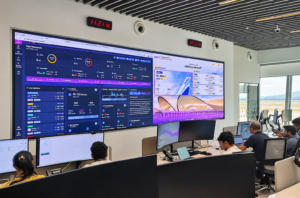
Ghosh reports reductions of up to 20 percent in passenger processing times, although she cautions against attributing these improvements solely to aviio. Other initiatives, including India’s DigiYatra biometric processing system, are contributing to faster passenger journeys.

Adani anticipates a further 10 percent reduction in processing time as computer vision analytics and information-sharing with airlines improve, although this remains a projection.

Predicting aircraft boarding times has proved particularly challenging. Ghosh says aviio’s predictions are around 70 percent accurate, reflecting the difficulty of accounting for incoming aircraft movements, turnaround activities and other airport disruptions.

Adani has identified around 145 turnaround milestones and is concentrating on approximately 60 for more detailed monitoring, including through computer vision. Improving predictions also requires consistency between aviio, flight information displays, airport databases and airline systems.

“If my mobile app says boarding won’t start for another 50 minutes, but the flight information displays say 25 minutes, people will turn up at the gate,” Ghosh says.

Adani is working with airlines to improve alignment between these information sources. The challenge is not generating predictions but ensuring they are reliable and consistent enough for passengers and operational teams to act upon.

Expanding the applications

At Guwahati Airport, even the toilets are connected to aviio. During a demonstration, Ghosh opens a dashboard showing individual facilities marked red, with sensor information on occupancy and supplies, including soap, paper and even odours. The system can flag problems to staff responsible for resolving them.

Other dashboards monitor gate utilisation and aircraft turnaround performance. Energy management offers another application, with flight schedules and terminal usage data potentially helping airports adjust heating, ventilation and air-conditioning systems when parts of a terminal are not required.

Adani is also exploring commercial applications for retailers, food and beverage operators and duty-free businesses. More detailed footfall, purchasing and store performance analytics could eventually be offered through paid subscriptions, unlike the operational information provided free to airlines and security partners.

The group is open to collaborating with other airport operators interested in adopting and developing the platform. Although aviio was originally built to establish a consistent approach to measuring performance across Adani’s eight airports, Ghosh sees potential for broader industry use.

“We want to make this a platform that can help with a larger cause: passenger experience and reducing processing times, rather than trying to monetise the platform itself,” she says.

Main image: HitmanH | Dreamstime.com

How Atlanta is using computer vision for operational intelligence

A driver stops on the road near the airport terminal, unwilling to pay for parking. Another follows suit, and then another.

“Before you know it, other cars will partake in the same behaviour, and then you have a backup,” says Chris Crist, Chief Information Officer, Hartsfield-Jackson Atlanta International Airport. “Suddenly you have traffic issues, and then safety issues.”

For Hartsfield-Jackson airport, this everyday frustration has provided a starting point to deploy computer vision–AI that analyses camera footage to identify objects and activity–to help security teams intervene.

The airport’s approximately 7,000 cameras provide extensive coverage, but tracking an incident across that network places considerable demands on security professionals. Crist illustrates the problem with a hypothetical example: someone leaves a bag unattended and runs away.

Chris Crist, Chief Information Officer, Hartsfield-Jackson Atlanta International Airport

“When a security professional is notified, of course they have some basic questions like, okay, well, ‘what did this individual look like?’” he says. “And maybe all they get is, ‘they were in a blue hat, red jacket. They were tall. They’re a man. They’re running a certain direction.’”

Previously, staff had to search footage manually, piecing together where to look next. The overlay allows them to retrieve potential matches using visible characteristics, then assess the results.

“You simply type in those characteristics as filters,” Crist explains. “The AI overlay will immediately within seconds find all of those who match those characteristics, no matter where they are, and then they can narrow down from there.”

Describing the benefits for the security team, he adds: “The security professionals have been able to reduce their security response times from four hours to one hour, so a 75 percent reduction.”

The initial deployment covers 1,800 cameras in terminal areas, encompassing kerbside activity and passengers entering and waiting at security checkpoints. Selecting these locations gave the airport a defined operational starting point before considering broader applications.

The first cameras serve the international terminal on the east side and domestic terminal facilities to the west. That leaves much of the network outside the initial deployment, with expansion guided by what the operational teams learn from the system and which problems they want to tackle next.

Making alerts useful

For vehicles stopping where they should not, security staff notify colleagues on patrol to attend and move them along. Establishing when that intervention is warranted required adjustment.

“Initially they said, ‘Oh, we want to know as soon as a car is sitting there for 30 seconds’, but we realise that’s probably not enough time [to justify an intervention],” Crist explains.

They tested progressively longer periods, from two minutes to four or five. Working with the security department helped distinguish situations requiring attention from ordinary pauses in airport traffic, while keeping notifications manageable.

“The whole idea is start small, fail fast, learn fast,” he says. “We started with something that wasn’t so exciting.”

Crist says kerbside behaviour might generate around a dozen alerts on some days, although conditions vary. Setting the thresholds together gives the security department a role in determining how the technology fits its workload, rather than simply receiving whatever notifications a system produces.

When discussing impact, Crist identifies kerbside incident response as the application for which the airport currently has data. Although staff also use the overlay to find people of interest, its impact on those searches has not yet been measured.

When the room overheated

The computer vision software arrived already trained to recognise objects, leaving the airport responsible for installing the supporting infrastructure. Crist found little direct experience to draw on among his industry contacts.

“There was nobody I could talk to that said that they had done this, and so we just had to figure it out,” he says.

A substantial installation of on-site hardware went into the airport’s intermediate distribution frame rooms, often described as IT equipment rooms. The equipment relied heavily on graphics processing units, bringing power and cooling requirements that the team had underestimated.

“We put all of the new hardware into one room, and that was a mistake because we didn’t realise how much heat this would generate,” says Crist.

Systems began shutting down, forcing the team to investigate. The solution involved redistributing the hardware across different rooms, sharing the load between separate cooling units.

The hardware experience offers another practical consideration for airports assessing similar projects: reusing cameras still requires investment behind the scenes. Processing their footage introduced infrastructure demands that had to be resolved before the capability could operate reliably.

The next intended application concerns the Plane Train, which carries passengers through the airport. The overlay would identify when a train remains stationary longer than expected.

“Whenever something happens to one, we have to go through a very manual process of hoping that some security professional sees that it’s down or a passenger lets somebody know, which is too long,” Crist says.

The airport already holds response-time data for this process, providing a baseline for assessing the planned application. Other prospective uses include identifying passengers entering the wrong route when different security processes apply and detecting someone following an employee through a controlled door without scanning their own credentials.

(c) Thomas Barrat | Dreamstime.com

Bringing people with the technology

For the initial deployment, support came from the chief of physical security, who championed the idea and secured funding. Her team worked with IT to put the system into operation.

“Her teams were committed,” Crist says. “We’ve added more to our plates of responsibility, but it just shows you the value that they place on this product.”

When the capability becomes unavailable, security staff now call IT to have it restored immediately.

Crist is also managing a broader organisational change. Within the past month, an innovation division has moved under IT, with a Chief Innovation Officer reporting to him. Its four business units cover sustainability, business performance, organisation-wide strategy and innovation.

“You’re now having to integrate this new thing into your IT department,” he says.

The restructuring requires teams to find ways of working together and integrating their processes.

This will be one of the key topics Crist will share with peers at the upcoming AAA Leadership Forum, which Atlanta Hartsfield Jackson will host on 28–29 October.

“It’d be great to learn from others on how they’re navigating change management in their airports through people,” Crist says. “I’d love to be just open and candid about the challenges of doing that. And then of course some of the successes that we’ve had, and trying to move that forward too.”

Main image: Toi Ne | Dreamstime.com

AI-monitored aircraft turnarounds outperform industry benchmark

Aircraft turnarounds monitored using artificial intelligence (AI) are running more than a third closer to schedule than the industry benchmark, according to a new report from aviation technology company Assaia.

The company’s 2026 Turnaround Benchmark Report compared approximately 125,000 AI-monitored turnarounds at eight major airports in Europe and North America with 1.5 million turnarounds at 20 comparable airports. During the first quarter of 2026, AI-monitored operations exceeded scheduled turnaround times by an average of 7.3 minutes, compared with 11.4 minutes at the benchmark airports.

Christiaan Hen, CEO of Assaia, told the Airports AI Alliance that the findings demonstrate the potential of real-time monitoring, although other operational factors also influence performance.

Christiaan Hen, CEO of Assaia

“While this comparative analysis cannot establish that AI monitoring alone caused the difference, the findings are consistent with the operational benefits of real-time visibility,” he said. “Assaia’s computer vision technology automatically tracks critical turnaround activities, including baggage handling, refuelling and catering, enabling teams to identify deviations from plan as they happen and intervene before small delays escalate.”

Where delays accumulate

The report also analysed more than 750,000 turnarounds captured by computer vision systems to identify where operations fall behind schedule.

It found that the best and worst-performing turnarounds follow almost identical timelines during their first 12 minutes. Delays subsequently accumulate across activities such as catering, refuelling and baggage handling, often without any single major disruption.

Baggage loading emerged as a particular bottleneck, taking a median of 24.8 minutes during the worst-performing turnarounds, compared with 11.3 minutes during the best.

Hen said the involvement of multiple airlines and ground handlers, often operating different systems, makes identifying problems particularly difficult. AI monitoring can provide a shared picture of activities across aircraft stands, allowing teams to respond before delays affect departures.

“Over time, the data also helps airports and their partners identify recurring bottlenecks,” he said. “This allows them to make more informed decisions about staffing, scheduling and processes, improving efficiency across multiple airlines and handling partners rather than addressing each delay in isolation.”

Results at individual airports

Hen highlighted several airports reporting operational improvements following the introduction of AI-powered turnaround monitoring.

At Berlin Brandenburg Airport, Hen said the introduction of the technology alongside a dedicated operational resilience team has helped reduce ground delays by 69 percent and improve departure readiness by two minutes.

At Rome Fiumicino, passenger boarding bridges are being connected one minute earlier and passenger stairs positioned nearly two minutes earlier. He said airlines at the airport have also recorded a six-minute year-on-year reduction in average departure delays.

At JFK Terminal 4, average ground delays have fallen by five minutes per flight, while the proportion of arriving aircraft finding an available gate has increased by 25 percent, representing an estimated US$40 million in potential annual savings.

And at Toronto Pearson, Air Canada flights actively managed using the technology recorded 3.4 minutes less ground delay on average than other flights during the same period.

Hen said improving turnaround performance could also help airports accommodate growing passenger demand without immediately investing in additional infrastructure.

“Airport capacity is about more than the number of gates available. It’s also about how efficiently those gates are used,” he said.

Main image: Anyaivanova | Dreamstime.com

How Schiphol is using AI from turnarounds to cleaning

Amsterdam Airport Schiphol handles around 70 million passengers a year through a terminal designed for about 50 million. With major renovation and renewal projects not expected to create additional capacity until around 2034, the airport, like many across the world, is looking at how technology can help it make better use of existing space and resources.

Its technology programme is focused on three areas: passenger experience, capacity, and labour productivity. Annemijn Schoenmaker, Head of Business Platform Infrastructure & IT Projects within Digital & Technology at Royal Schiphol Group, says those priorities increasingly overlap as the airport deals with constraints on space and people.

Annemijn Schoenmaker, Head of Business Platform Infrastructure & IT Projects within Digital & Technology at Royal Schiphol Group

“We have these scarcities, like scarcity of capacity, scarcity of labour, scarcity of environmental resources,” she tells the Airports AI Alliance. “And then we have all these business processes which may be affected by one of these scarcities or more. Wherever there’s a perfect combination of both having a capacity scarcity and the labour scarcity, then we try and solve those problems with technology.”

Schiphol organises applied technology around its infrastructure, commercial and operations businesses, keeping development tied to operational needs. While it builds some systems itself, Schoenmaker says the airport is increasingly looking outside where suitable technology already exists.

“We prefer a fast follower approach right now rather than first mover,” she says. “So we try and increase collaborations also with external specialist parties. They might have LLMs developed already, for example, that we can adopt.”

Deep Turnaround

One area where Schiphol has developed its own technology was aircraft turnaround. The project began in 2018, when the airport had extensive information about arriving and departing flights but much less visibility over activity at the stand.

“We had all the data from inbound flights and outbound flights,” says Marcel Stroop, Director of Go-To-Market at Schiphol Group. “We had all the data from passengers, what’s happening in terminal, but what was happening during the turnaround was a complete black hole.”

Cameras around aircraft stands capture refuelling, catering and pushback activities with computer vision converting the images into operational events. By 2023, the system had evolved beyond monitoring to forecasting when processes would finish, when an aircraft would be ready to depart and whether delays could create gate conflicts.

“A prediction doesn’t really do anything because a prediction doesn’t move an aircraft,” says Stroop. “So how could we actually make sure that the person that needed to act on this prediction does something?”

That shifted the focus towards what Stroop calls “coordinated action”, getting information to airlines, ground handlers, gate planners and other partners in forms they could use. Integration was complicated by strict aviation rules governing where information comes from and who can enter it, while existing data standards were not designed for all the new events being generated.

Deep Turnaround was developed by an in-house product team within Digital & Technology, with operational teams setting the requirements. Local partners can support elements such as hardware installation. Investment sits within Schiphol’s wider technology portfolio, backed by an operational business sponsor, and competes with other technology priorities for funding.

While Deep Turnaround was developed and deployed at Schiphol, the airport also saw potential for its predictions to be used beyond its own operations. Discussions with Eurocontrol, the pan-European organisation that helps coordinate air traffic management across the region, began around 2019. This led to a separate pilot at Eindhoven Airport between June and August 2026, testing how Deep Turnaround predictions could be incorporated into Eurocontrol’s air traffic management processes.

Marcel Stroop, Director of Go-To-Market at Schiphol Group

Stroop gives the example of an aircraft completing its turnaround and being ready to leave, only to sit at the airport with passengers on board for another 20 minutes because its allocated take-off slot has not been given. Better predictions of when aircraft are ready could give Eurocontrol more accurate information when managing those slots.

Schiphol had expected its predictions to run in the background during the Eindhoven trial, alongside Eurocontrol’s existing system. Instead, Stroop says Eurocontrol used the model incorporating Deep Turnaround predictions live and ran its existing approach in shadow mode. He says the pilot cut waiting time by a “considerable amount of minutes”, although the precise figure was not available for publication.

In Amsterdam, adoption depended on operating partners and frontline employees seeing a practical benefit. Stroop says the airport initially assumed that the national carrier KLM would be central to adoption because of the number of flights it operates out of Schiphol. Instead, the team began with smaller airlines and easyJet, for example, together with its ground handler, became strong supporters of the technology.

Schoenmaker adds that helped build momentum with the larger operators. “You kind of create a bit of competition,” she says. “Prove it, get a bit of the jealousy going, and then the big ones adopt it.”
For employees on the apron, the benefits also had to be tangible. A tow-truck driver, for example, may previously have been allocated to an aircraft set well in advance.

“In the old situation, they would do that based on a timestamp which was set a week ago,” Stroop says. “So the tow truck would just sit there idle, sometimes for 20 minutes, not doing anything because the plane was not ready yet.”

Live information on smart watches, phones or tablets lets the driver see whether another aircraft is ready sooner and change the sequence.

“All of a sudden, [the driver] does two pushbacks in, for example, 10 minutes instead of one,” Stroop says. “That’s where you really see them say, ‘Oh wow, it also improved my own work.’”

The interface was deliberately kept basic for employees already working under complex airside safety requirements. “It’s really about keeping it as simple as possible. Less is more,” says Stroop.

Deep Turnaround has achieved a 3.6 percent improvement in on-time performance at Schiphol according to Stroop, alongside an 11 percent reduction in missed runway slots. Schiphol began commercialising the technology in 2023, allowing other airports to deploy it while feeding lessons back into the product.

Image: Menzies/Schiphol

Clean & Tidy

The second application tackles a different part of airport operations. Schiphol’s Clean & Tidy initiative uses passenger-flow and facilities data to help cleaning companies decide how to deploy staff and maintain quality across the terminal.

One challenge is Schiphol Plaza, a shared space that does not fit neatly into traditional airport passenger forecasting. “The place they pass through is a shopping mall and it’s also a train station,” Schoenmaker says. “So it’s not just an airport-specific spot.”

Schiphol had historically begun tracking departing passengers from the check-in desks, after they had moved through the Plaza. The airport therefore developed forecasts for how busy the area would become. These feed into the Smart Facilities Dashboard, which brings together passenger flows, cleaning activity and quality measures to help contractors schedule staff.

Unlike Deep Turnaround, the approach does not require a new layer of cameras or dedicated hardware. It makes greater use of data already available across the airport and its partners. For Schoenmaker, the focus also reflects how quickly passengers form an impression of an airport. “From a cleanliness perspective, Plaza is very important,” she says. “It makes first impressions really important.”

Passenger feedback buttons provide one measure of performance. Schiphol reports that its overall quality indicator has risen by 12 percent since the Clean & Tidy initiative began, with the Smart Facilities Dashboard a key contributor. The figure covers the broader initiative rather than isolating the effect of AI forecasting.

The next phase is intended to connect forecasts more closely with cleaning hours, expected quality and costs. Schiphol’s work is still being developed with contractors, with current examples using dummy data rather than operational results.

The two projects operate in very different environments, but both show the importance of getting predictions to the people able to act on them. For Stroop, that practical impact ultimately determines whether the technology becomes useful in day-to-day operations.

“The moment staff see they can do something with it, is when they see it actually makes an impact on their work.”


Want to go deeper on airport AI?

Annemijn Schoenmaker also features in the Airports AI Alliance Playbook: How to Deploy Artificial Intelligence to Transform Airport Operations, sharing practical insights from Schiphol alongside airport leaders and AI experts.

The Playbook explores how airports can move from AI experimentation to real-world deployment, with guidance and case studies covering operations, passenger experience and infrastructure.

The full Playbook is available exclusively to Airports AI Alliance members.

Main image: Menzies/Schiphol

Inside the evolution of airport AI

Long before artificial intelligence entered the mainstream through generative AI, Searidge Technologies was applying computer vision to airport operations.

Now, as the company joins the Airports AI Alliance, Marco Rueckert (pictured), Chief Technology Officer at Searidge, says the evolution of airport AI has been shaped less by breakthroughs in algorithms than by solving practical operational challenges, from aircraft surveillance to turnaround management and airside safety.

“When we started in 2006 it was really about trying to provide visual systems that could provide gap filler enhancement to radars,” Rueckert says.

At the time, airports looking to improve surface surveillance often faced limitations created by new hangars and other infrastructure that blocked radar coverage. Rather than installing additional radar systems, Searidge developed computer vision technology that used cameras to detect aircraft and convert those detections into position data, supplementing existing surveillance systems.

Detecting aircraft from video feeds was far from straightforward. Before advances in machine learning, engineers relied on manually programmed algorithms that identified changes in image brightness before determining whether those changes represented an aircraft.

“We worked with a research institute in Quebec to analyse images and detect aircraft,” Rueckert says. “That was before all these advances of AI. At the time it was very difficult because you ended up doing really complicated, PhD-written algorithms that detected luminance changes in the image.”

Those systems required continual refinement to account for changing light, shadows and seasonal conditions.

“We always ended up having to tune it really differently,” he says. “If there were shadows, if there was moving grass, if it was winter versus summer, we had to spend a lot of time fine tuning it.”

Machine learning transformed the process. Rather than writing increasingly complex rules, engineers could train models using thousands of labelled aircraft images, allowing systems to recognise aircraft across a much wider range of operating conditions.

“When we then got into AI, what we found immediately was that AI was able to abstract a lot of this away from us,” Rueckert says. “You just showed it 1,000 images of an aircraft and then it figured out how to learn what an aircraft is.

“The development cycle to get to that level of system performance was dramatically different. You’re talking orders of magnitude difference between developing the original traditionally programmed expert system versus the AI system.”

One of the company’s early deployments using machine learning was at Fort Lauderdale-Hollywood International Airport, where thermal cameras were used to detect aircraft. Because publicly available thermal image datasets were limited at the time, Searidge developed its own training data to support the deployment.

Today, the company’s work extends well beyond aircraft detection. One of the strongest areas of demand is turnaround management, where computer vision automatically records operational milestones including on-block and off-block times, chocks on and off, safety walks and baggage handling events. The resulting operational data reduces manual reporting while providing airports and airlines with a more accurate picture of aircraft turnarounds.

“We’re seeing quite a lot of strong market demand for turnaround systems,” Rueckert says.

Another area of growth is improving airside safety. Searidge has developed AI systems that analyse aircraft and vehicle movements at service road crossings, using computer vision together with operational data to determine when vehicles can safely cross active taxiways. The systems also account for operational scenarios such as aircraft pushbacks, where jet blast can create additional hazards.

Rueckert says interest in these applications has increased as airports respond to changes in airside operations following the pandemic.

“What we’re doing is applying AI to detect vehicles and aircraft in real time and then making decisions on which traffic lights are going to turn red and which traffic lights are going to turn green,” he says.

As airport AI has matured, conversations with customers have also changed.

“I don’t have to go to airport CTOs anymore and convince them that AI is something that is real,” Rueckert says. “The real challenge now is about return on investment.”

Airport operators increasingly expect AI projects to deliver measurable operational benefits within existing budget cycles while balancing infrastructure costs, computing requirements and energy consumption.

Rueckert believes the next stage of airport AI will depend on engineering discipline as much as advances in artificial intelligence. Systems deployed in operational environments must be able to monitor their own performance, detect faults and respond safely when conditions change, particularly in safety-critical applications.

He also sees a need for greater collaboration across the aviation industry to develop common approaches to deploying AI in operational environments.

For Searidge, joining the Airports AI Alliance reflects that broader direction. Having spent nearly two decades developing computer vision applications for airports, the company is looking to contribute practical experience as airports move beyond AI pilots and focus on deploying operational systems that deliver measurable improvements in efficiency, safety and day-to-day airport performance.

Images: Searidge Technologies