

Inside the evolution of airport AI
Long before artificial intelligence entered the mainstream through generative AI, Searidge Technologies was applying computer vision to airport operations.
Now, as the company joins the Airports AI Alliance, Marco Rueckert (pictured), Chief Technology Officer at Searidge, says the evolution of airport AI has been shaped less by breakthroughs in algorithms than by solving practical operational challenges, from aircraft surveillance to turnaround management and airside safety.
“When we started in 2006 it was really about trying to provide visual systems that could provide gap filler enhancement to radars,” Rueckert says.
At the time, airports looking to improve surface surveillance often faced limitations created by new hangars and other infrastructure that blocked radar coverage. Rather than installing additional radar systems, Searidge developed computer vision technology that used cameras to detect aircraft and convert those detections into position data, supplementing existing surveillance systems.
Detecting aircraft from video feeds was far from straightforward. Before advances in machine learning, engineers relied on manually programmed algorithms that identified changes in image brightness before determining whether those changes represented an aircraft.
“We worked with a research institute in Quebec to analyse images and detect aircraft,” Rueckert says. “That was before all these advances of AI. At the time it was very difficult because you ended up doing really complicated, PhD-written algorithms that detected luminance changes in the image.”
Those systems required continual refinement to account for changing light, shadows and seasonal conditions.
“We always ended up having to tune it really differently,” he says. “If there were shadows, if there was moving grass, if it was winter versus summer, we had to spend a lot of time fine tuning it.”
Machine learning transformed the process. Rather than writing increasingly complex rules, engineers could train models using thousands of labelled aircraft images, allowing systems to recognise aircraft across a much wider range of operating conditions.
“When we then got into AI, what we found immediately was that AI was able to abstract a lot of this away from us,” Rueckert says. “You just showed it 1,000 images of an aircraft and then it figured out how to learn what an aircraft is.
“The development cycle to get to that level of system performance was dramatically different. You’re talking orders of magnitude difference between developing the original traditionally programmed expert system versus the AI system.”
One of the company’s early deployments using machine learning was at Fort Lauderdale-Hollywood International Airport, where thermal cameras were used to detect aircraft. Because publicly available thermal image datasets were limited at the time, Searidge developed its own training data to support the deployment.
Today, the company’s work extends well beyond aircraft detection. One of the strongest areas of demand is turnaround management, where computer vision automatically records operational milestones including on-block and off-block times, chocks on and off, safety walks and baggage handling events. The resulting operational data reduces manual reporting while providing airports and airlines with a more accurate picture of aircraft turnarounds.
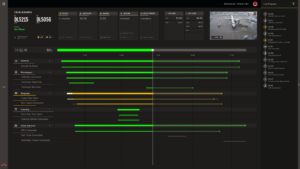
“We’re seeing quite a lot of strong market demand for turnaround systems,” Rueckert says.
Another area of growth is improving airside safety. Searidge has developed AI systems that analyse aircraft and vehicle movements at service road crossings, using computer vision together with operational data to determine when vehicles can safely cross active taxiways. The systems also account for operational scenarios such as aircraft pushbacks, where jet blast can create additional hazards.
Rueckert says interest in these applications has increased as airports respond to changes in airside operations following the pandemic.
“What we’re doing is applying AI to detect vehicles and aircraft in real time and then making decisions on which traffic lights are going to turn red and which traffic lights are going to turn green,” he says.
As airport AI has matured, conversations with customers have also changed.
“I don’t have to go to airport CTOs anymore and convince them that AI is something that is real,” Rueckert says. “The real challenge now is about return on investment.”
Airport operators increasingly expect AI projects to deliver measurable operational benefits within existing budget cycles while balancing infrastructure costs, computing requirements and energy consumption.
Rueckert believes the next stage of airport AI will depend on engineering discipline as much as advances in artificial intelligence. Systems deployed in operational environments must be able to monitor their own performance, detect faults and respond safely when conditions change, particularly in safety-critical applications.
He also sees a need for greater collaboration across the aviation industry to develop common approaches to deploying AI in operational environments.
For Searidge, joining the Airports AI Alliance reflects that broader direction. Having spent nearly two decades developing computer vision applications for airports, the company is looking to contribute practical experience as airports move beyond AI pilots and focus on deploying operational systems that deliver measurable improvements in efficiency, safety and day-to-day airport performance.
Images: Searidge Technologies