
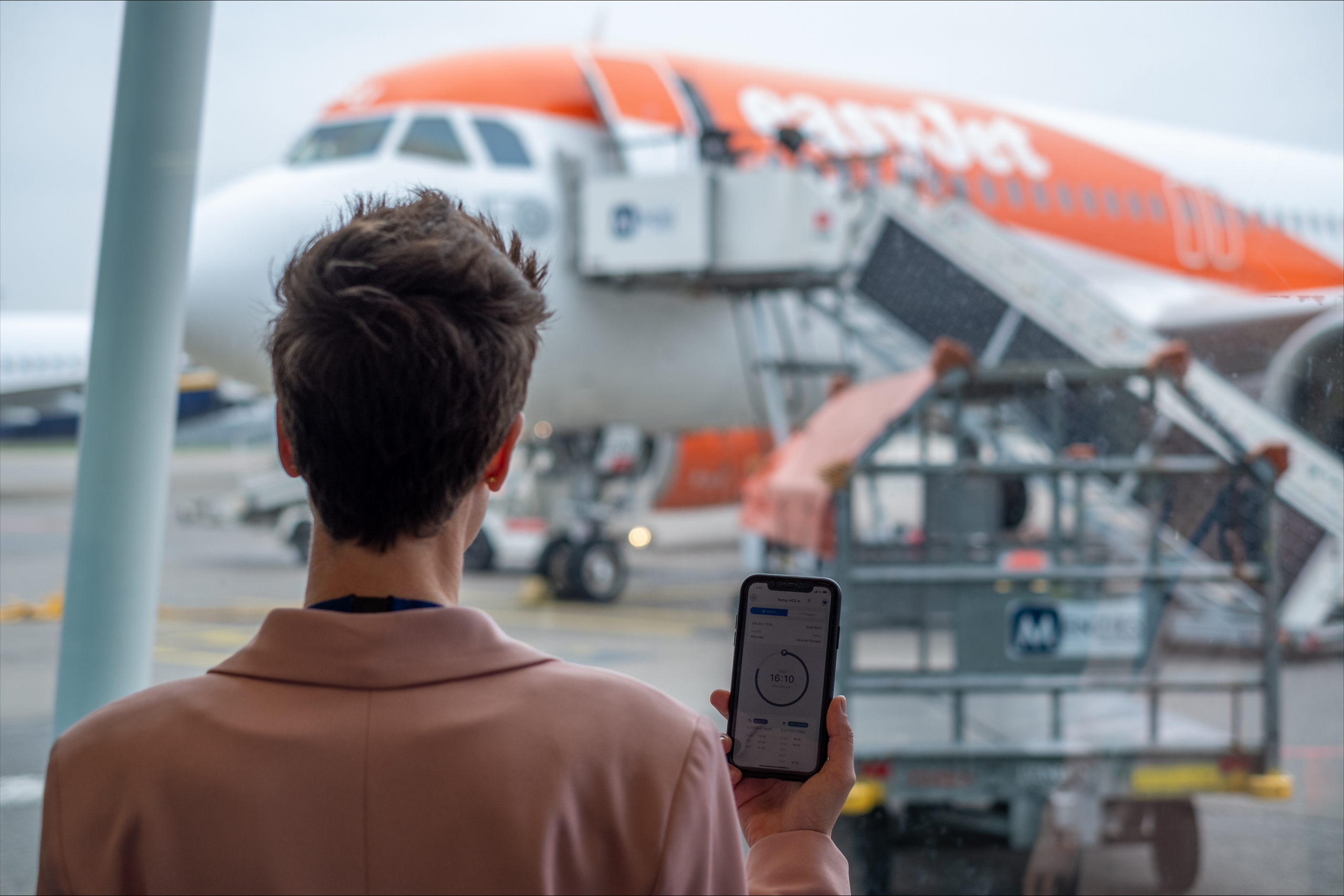
How Schiphol is using AI from turnarounds to cleaning
Amsterdam Airport Schiphol handles around 70 million passengers a year through a terminal designed for about 50 million. With major renovation and renewal projects not expected to create additional capacity until around 2034, the airport, like many across the world, is looking at how technology can help it make better use of existing space and resources.
Its technology programme is focused on three areas: passenger experience, capacity, and labour productivity. Annemijn Schoenmaker, Head of Business Platform Infrastructure & IT Projects within Digital & Technology at Royal Schiphol Group, says those priorities increasingly overlap as the airport deals with constraints on space and people.

Annemijn Schoenmaker, Head of Business Platform Infrastructure & IT Projects within Digital & Technology at Royal Schiphol Group
“We have these scarcities, like scarcity of capacity, scarcity of labour, scarcity of environmental resources,” she tells the Airports AI Alliance. “And then we have all these business processes which may be affected by one of these scarcities or more. Wherever there’s a perfect combination of both having a capacity scarcity and the labour scarcity, then we try and solve those problems with technology.”
Schiphol organises applied technology around its infrastructure, commercial and operations businesses, keeping development tied to operational needs. While it builds some systems itself, Schoenmaker says the airport is increasingly looking outside where suitable technology already exists.
“We prefer a fast follower approach right now rather than first mover,” she says. “So we try and increase collaborations also with external specialist parties. They might have LLMs developed already, for example, that we can adopt.”
Deep Turnaround
One area where Schiphol has developed its own technology was aircraft turnaround. The project began in 2018, when the airport had extensive information about arriving and departing flights but much less visibility over activity at the stand.
“We had all the data from inbound flights and outbound flights,” says Marcel Stroop, Director of Go-To-Market at Schiphol Group. “We had all the data from passengers, what’s happening in terminal, but what was happening during the turnaround was a complete black hole.”
Cameras around aircraft stands capture refuelling, catering and pushback activities with computer vision converting the images into operational events. By 2023, the system had evolved beyond monitoring to forecasting when processes would finish, when an aircraft would be ready to depart and whether delays could create gate conflicts.
“A prediction doesn’t really do anything because a prediction doesn’t move an aircraft,” says Stroop. “So how could we actually make sure that the person that needed to act on this prediction does something?”
That shifted the focus towards what Stroop calls “coordinated action”, getting information to airlines, ground handlers, gate planners and other partners in forms they could use. Integration was complicated by strict aviation rules governing where information comes from and who can enter it, while existing data standards were not designed for all the new events being generated.
Deep Turnaround was developed by an in-house product team within Digital & Technology, with operational teams setting the requirements. Local partners can support elements such as hardware installation. Investment sits within Schiphol’s wider technology portfolio, backed by an operational business sponsor, and competes with other technology priorities for funding.
While Deep Turnaround was developed and deployed at Schiphol, the airport also saw potential for its predictions to be used beyond its own operations. Discussions with Eurocontrol, the pan-European organisation that helps coordinate air traffic management across the region, began around 2019. This led to a separate pilot at Eindhoven Airport between June and August 2026, testing how Deep Turnaround predictions could be incorporated into Eurocontrol’s air traffic management processes.

Marcel Stroop, Director of Go-To-Market at Schiphol Group
Stroop gives the example of an aircraft completing its turnaround and being ready to leave, only to sit at the airport with passengers on board for another 20 minutes because its allocated take-off slot has not been given. Better predictions of when aircraft are ready could give Eurocontrol more accurate information when managing those slots.
Schiphol had expected its predictions to run in the background during the Eindhoven trial, alongside Eurocontrol’s existing system. Instead, Stroop says Eurocontrol used the model incorporating Deep Turnaround predictions live and ran its existing approach in shadow mode. He says the pilot cut waiting time by a “considerable amount of minutes”, although the precise figure was not available for publication.
In Amsterdam, adoption depended on operating partners and frontline employees seeing a practical benefit. Stroop says the airport initially assumed that the national carrier KLM would be central to adoption because of the number of flights it operates out of Schiphol. Instead, the team began with smaller airlines and easyJet, for example, together with its ground handler, became strong supporters of the technology.
Schoenmaker adds that helped build momentum with the larger operators. “You kind of create a bit of competition,” she says. “Prove it, get a bit of the jealousy going, and then the big ones adopt it.”
For employees on the apron, the benefits also had to be tangible. A tow-truck driver, for example, may previously have been allocated to an aircraft set well in advance.
“In the old situation, they would do that based on a timestamp which was set a week ago,” Stroop says. “So the tow truck would just sit there idle, sometimes for 20 minutes, not doing anything because the plane was not ready yet.”
Live information on smart watches, phones or tablets lets the driver see whether another aircraft is ready sooner and change the sequence.
“All of a sudden, [the driver] does two pushbacks in, for example, 10 minutes instead of one,” Stroop says. “That’s where you really see them say, ‘Oh wow, it also improved my own work.’”
The interface was deliberately kept basic for employees already working under complex airside safety requirements. “It’s really about keeping it as simple as possible. Less is more,” says Stroop.
Deep Turnaround has achieved a 3.6 percent improvement in on-time performance at Schiphol according to Stroop, alongside an 11 percent reduction in missed runway slots. Schiphol began commercialising the technology in 2023, allowing other airports to deploy it while feeding lessons back into the product.
Image: Menzies/Schiphol
Clean & Tidy
The second application tackles a different part of airport operations. Schiphol’s Clean & Tidy initiative uses passenger-flow and facilities data to help cleaning companies decide how to deploy staff and maintain quality across the terminal.
One challenge is Schiphol Plaza, a shared space that does not fit neatly into traditional airport passenger forecasting. “The place they pass through is a shopping mall and it’s also a train station,” Schoenmaker says. “So it’s not just an airport-specific spot.”
Schiphol had historically begun tracking departing passengers from the check-in desks, after they had moved through the Plaza. The airport therefore developed forecasts for how busy the area would become. These feed into the Smart Facilities Dashboard, which brings together passenger flows, cleaning activity and quality measures to help contractors schedule staff.
Unlike Deep Turnaround, the approach does not require a new layer of cameras or dedicated hardware. It makes greater use of data already available across the airport and its partners. For Schoenmaker, the focus also reflects how quickly passengers form an impression of an airport. “From a cleanliness perspective, Plaza is very important,” she says. “It makes first impressions really important.”
Passenger feedback buttons provide one measure of performance. Schiphol reports that its overall quality indicator has risen by 12 percent since the Clean & Tidy initiative began, with the Smart Facilities Dashboard a key contributor. The figure covers the broader initiative rather than isolating the effect of AI forecasting.
The next phase is intended to connect forecasts more closely with cleaning hours, expected quality and costs. Schiphol’s work is still being developed with contractors, with current examples using dummy data rather than operational results.
The two projects operate in very different environments, but both show the importance of getting predictions to the people able to act on them. For Stroop, that practical impact ultimately determines whether the technology becomes useful in day-to-day operations.
“The moment staff see they can do something with it, is when they see it actually makes an impact on their work.”
Want to go deeper on airport AI?
Annemijn Schoenmaker also features in the Airports AI Alliance Playbook: How to Deploy Artificial Intelligence to Transform Airport Operations, sharing practical insights from Schiphol alongside airport leaders and AI experts.
The Playbook explores how airports can move from AI experimentation to real-world deployment, with guidance and case studies covering operations, passenger experience and infrastructure.
The full Playbook is available exclusively to Airports AI Alliance members.
Main image: Menzies/Schiphol