Tag Archive for: airport operations

AI-monitored aircraft turnarounds outperform industry benchmark

Aircraft turnarounds monitored using artificial intelligence (AI) are running more than a third closer to schedule than the industry benchmark, according to a new report from aviation technology company Assaia.

The company’s 2026 Turnaround Benchmark Report compared approximately 125,000 AI-monitored turnarounds at eight major airports in Europe and North America with 1.5 million turnarounds at 20 comparable airports. During the first quarter of 2026, AI-monitored operations exceeded scheduled turnaround times by an average of 7.3 minutes, compared with 11.4 minutes at the benchmark airports.

Christiaan Hen, CEO of Assaia, told the Airports AI Alliance that the findings demonstrate the potential of real-time monitoring, although other operational factors also influence performance.

Christiaan Hen, CEO of Assaia

“While this comparative analysis cannot establish that AI monitoring alone caused the difference, the findings are consistent with the operational benefits of real-time visibility,” he said. “Assaia’s computer vision technology automatically tracks critical turnaround activities, including baggage handling, refuelling and catering, enabling teams to identify deviations from plan as they happen and intervene before small delays escalate.”

Where delays accumulate

The report also analysed more than 750,000 turnarounds captured by computer vision systems to identify where operations fall behind schedule.

It found that the best and worst-performing turnarounds follow almost identical timelines during their first 12 minutes. Delays subsequently accumulate across activities such as catering, refuelling and baggage handling, often without any single major disruption.

Baggage loading emerged as a particular bottleneck, taking a median of 24.8 minutes during the worst-performing turnarounds, compared with 11.3 minutes during the best.

Hen said the involvement of multiple airlines and ground handlers, often operating different systems, makes identifying problems particularly difficult. AI monitoring can provide a shared picture of activities across aircraft stands, allowing teams to respond before delays affect departures.

“Over time, the data also helps airports and their partners identify recurring bottlenecks,” he said. “This allows them to make more informed decisions about staffing, scheduling and processes, improving efficiency across multiple airlines and handling partners rather than addressing each delay in isolation.”

Results at individual airports

Hen highlighted several airports reporting operational improvements following the introduction of AI-powered turnaround monitoring.

At Berlin Brandenburg Airport, Hen said the introduction of the technology alongside a dedicated operational resilience team has helped reduce ground delays by 69 percent and improve departure readiness by two minutes.

At Rome Fiumicino, passenger boarding bridges are being connected one minute earlier and passenger stairs positioned nearly two minutes earlier. He said airlines at the airport have also recorded a six-minute year-on-year reduction in average departure delays.

At JFK Terminal 4, average ground delays have fallen by five minutes per flight, while the proportion of arriving aircraft finding an available gate has increased by 25 percent, representing an estimated US$40 million in potential annual savings.

And at Toronto Pearson, Air Canada flights actively managed using the technology recorded 3.4 minutes less ground delay on average than other flights during the same period.

Hen said improving turnaround performance could also help airports accommodate growing passenger demand without immediately investing in additional infrastructure.

“Airport capacity is about more than the number of gates available. It’s also about how efficiently those gates are used,” he said.

Main image: Anyaivanova | Dreamstime.com

Glasgow Airport selects three SMEs for technology trials

Glasgow Airport will trial three technologies aimed at improving passenger experience and asset maintenance, including AI-powered feedback analysis and real-time congestion monitoring, with the potential for wider deployment across the AGS Airports group.

The trials, involving UK companies Beam Connectivity, Createc and Wordnerds, form part of the Connected Airport Living Lab programme, run by Connected Places Catapult in partnership with Glasgow Airport. They will be completed by the end of January 2027, with reporting and analysis scheduled for February and March.

Sameer Savani, Transport Managing Director at Connected Places Catapult (c) CPC

Sameer Savani, Transport Managing Director at Connected Places Catapult, told the Airports AI Alliance that the programme connects airports with smaller technology companies developing solutions to specific operational challenges.

“One core benefit of the programme is that it introduces our partner airport – in this case Glasgow Airport – to a tailored network of startups and SMEs with innovative solutions that can specifically address their challenges they’re looking to solve,” he said.

The Innovate UK-funded programme, now in its fourth year, provides selected companies with up to £30,000 in funding, commercial support and access to airport facilities to test their technologies in a live operational environment.

AI-powered passenger insights

Wordnerds will develop bespoke AI models using passenger feedback to identify recurring issues affecting the airport experience, including security queues, wayfinding and accessibility.

The company will use specialist classification models rather than generic generative AI tools, allowing airport teams to trace how feedback has been categorised and monitor changes over time. Potential sources include surveys, complaints, emails and social media, although these will be agreed during an initial discovery phase.

A Wordnerds spokesperson said: “Airport staff can ask questions in everyday language, and get answers based on counted, auditable data rather than an AI’s best guess. They don’t need to be analysts to understand what passengers are saying or to act on it.”

The system’s agentic reporting capabilities are also intended to flag emerging problems and help staff assess whether operational changes are improving passenger satisfaction.

Createc will trial its Situate platform, which combines privacy-preserving LiDAR sensors with AI and passenger feedback to monitor crowd density, movement and queue times.

They said: “In the short term, this could help airport teams identify emerging congestion, respond proactively and deploy resources where they’re needed most.”

The company hopes the resulting data will also inform longer-term decisions about staffing, space utilisation and infrastructure investment.

Meanwhile, Beam Connectivity will test its Connectivity as a Service platform, providing engineering teams with real-time information about the condition and performance of airport assets, including lifts, escalators, scanners and car park barriers. The technology aims to identify maintenance requirements earlier and reduce disruption to passengers.

Potential for wider deployment

Successful trials could lead to longer-term commercial deployments, although no commitments have been announced. Savani pointed to Hello Lamp Post, which secured a multi-airport contract with AGS Airports after participating in an earlier cohort.

“If the trials prove successful, the programme facilitates a direct route for deployment for the solutions to be implemented on a longer-term basis,” he said.

Main image: AGS Airports

Naviq joins AAA to help scale airport AI

Naviq has joined the Airports AI Alliance (AAA), with the recently launched company aiming to help airports make better use of operational data and move artificial intelligence beyond individual trials.

Launched in July as part of IBS Group, Naviq works across legacy system modernisation, cloud migration, operational data and AI, with a particular focus on connecting technologies and information that have traditionally sat in separate systems.

“Airports are modernising their legacy airport technology, and that spans from airport operational databases [AODB] to all kinds of supporting systems, on-prem to cloud migrations and bringing in new state-of-the-art SaaS solutions into their environment,” Kay Hellwig (pictured), Director of Sales, Europe and Africa at Naviq, told the Alliance.

“We help airports to anticipate disruptions rather than just react. How they can make better use of operational data, data and AI is a big topic, and we want to help them move from individual POCs to really an enterprise AI use that brings value to the airport.”

Hellwig highlighted a recent project with a customer that already held the information it needed but struggled to use it effectively because it was spread across different systems.

“The data is scattered across systems,” he said. “We have invested in a platform that accelerates bringing data together using AI.”

According to Hellwig, the customer was able to combine information from different sources three to five times faster than through a conventional data lake development process. Naviq then added pre-built key performance indicators and a platform on which further AI use cases could be developed.

“They’ve used that to create new KPIs that help them steer the business better and make better and faster decisions in their operational day-to-day work,” he said.

Hellwig sees a similar opportunity at an industry level, where operational information is divided between airports, airlines, ground handlers and other organisations.

“Sharing data is important because then you can gain other insights and you can optimise the system overall,” he said.

Greater data exchange with airport retailers could also open up commercial applications, although Hellwig said this would depend on appropriate platforms, a clear benefit for the organisations involved and sufficient trust to share information.

Through its AAA membership, Naviq plans to contribute experience from its work with airports, airlines and ground handlers while learning from deployments across the Alliance’s airport membership.

“It’s about really openly discussing what is happening, what works well, what doesn’t work well, best practice exchange, and that’s where we can contribute with our domain experience,” Hellwig said.

The company also sees the Alliance as an opportunity to test its assumptions about airports’ priorities against the experience of those implementing AI in operational environments.

“While we do a lot of research and we have industry experts, it’s always good to mirror our understanding and our view with the airports and see whether that’s the right thing or where else do we need to look,” Hellwig said.

For Hellwig, the longer-term shift is therefore less about replacing individual systems than changing how airports use technology, data and AI across their operations.

“What will happen is not just product replacements at airports,” he said. “It’s really changing how they work.”

Image: Naviq

How Schiphol is using AI from turnarounds to cleaning

Amsterdam Airport Schiphol handles around 70 million passengers a year through a terminal designed for about 50 million. With major renovation and renewal projects not expected to create additional capacity until around 2034, the airport, like many across the world, is looking at how technology can help it make better use of existing space and resources.

Its technology programme is focused on three areas: passenger experience, capacity, and labour productivity. Annemijn Schoenmaker, Head of Business Platform Infrastructure & IT Projects within Digital & Technology at Royal Schiphol Group, says those priorities increasingly overlap as the airport deals with constraints on space and people.

Annemijn Schoenmaker, Head of Business Platform Infrastructure & IT Projects within Digital & Technology at Royal Schiphol Group

“We have these scarcities, like scarcity of capacity, scarcity of labour, scarcity of environmental resources,” she tells the Airports AI Alliance. “And then we have all these business processes which may be affected by one of these scarcities or more. Wherever there’s a perfect combination of both having a capacity scarcity and the labour scarcity, then we try and solve those problems with technology.”

Schiphol organises applied technology around its infrastructure, commercial and operations businesses, keeping development tied to operational needs. While it builds some systems itself, Schoenmaker says the airport is increasingly looking outside where suitable technology already exists.

“We prefer a fast follower approach right now rather than first mover,” she says. “So we try and increase collaborations also with external specialist parties. They might have LLMs developed already, for example, that we can adopt.”

Deep Turnaround

One area where Schiphol has developed its own technology was aircraft turnaround. The project began in 2018, when the airport had extensive information about arriving and departing flights but much less visibility over activity at the stand.

“We had all the data from inbound flights and outbound flights,” says Marcel Stroop, Director of Go-To-Market at Schiphol Group. “We had all the data from passengers, what’s happening in terminal, but what was happening during the turnaround was a complete black hole.”

Cameras around aircraft stands capture refuelling, catering and pushback activities with computer vision converting the images into operational events. By 2023, the system had evolved beyond monitoring to forecasting when processes would finish, when an aircraft would be ready to depart and whether delays could create gate conflicts.

“A prediction doesn’t really do anything because a prediction doesn’t move an aircraft,” says Stroop. “So how could we actually make sure that the person that needed to act on this prediction does something?”

That shifted the focus towards what Stroop calls “coordinated action”, getting information to airlines, ground handlers, gate planners and other partners in forms they could use. Integration was complicated by strict aviation rules governing where information comes from and who can enter it, while existing data standards were not designed for all the new events being generated.

Deep Turnaround was developed by an in-house product team within Digital & Technology, with operational teams setting the requirements. Local partners can support elements such as hardware installation. Investment sits within Schiphol’s wider technology portfolio, backed by an operational business sponsor, and competes with other technology priorities for funding.

While Deep Turnaround was developed and deployed at Schiphol, the airport also saw potential for its predictions to be used beyond its own operations. Discussions with Eurocontrol, the pan-European organisation that helps coordinate air traffic management across the region, began around 2019. This led to a separate pilot at Eindhoven Airport between June and August 2026, testing how Deep Turnaround predictions could be incorporated into Eurocontrol’s air traffic management processes.

Marcel Stroop, Director of Go-To-Market at Schiphol Group

Stroop gives the example of an aircraft completing its turnaround and being ready to leave, only to sit at the airport with passengers on board for another 20 minutes because its allocated take-off slot has not been given. Better predictions of when aircraft are ready could give Eurocontrol more accurate information when managing those slots.

Schiphol had expected its predictions to run in the background during the Eindhoven trial, alongside Eurocontrol’s existing system. Instead, Stroop says Eurocontrol used the model incorporating Deep Turnaround predictions live and ran its existing approach in shadow mode. He says the pilot cut waiting time by a “considerable amount of minutes”, although the precise figure was not available for publication.

In Amsterdam, adoption depended on operating partners and frontline employees seeing a practical benefit. Stroop says the airport initially assumed that the national carrier KLM would be central to adoption because of the number of flights it operates out of Schiphol. Instead, the team began with smaller airlines and easyJet, for example, together with its ground handler, became strong supporters of the technology.

Schoenmaker adds that helped build momentum with the larger operators. “You kind of create a bit of competition,” she says. “Prove it, get a bit of the jealousy going, and then the big ones adopt it.”
For employees on the apron, the benefits also had to be tangible. A tow-truck driver, for example, may previously have been allocated to an aircraft set well in advance.

“In the old situation, they would do that based on a timestamp which was set a week ago,” Stroop says. “So the tow truck would just sit there idle, sometimes for 20 minutes, not doing anything because the plane was not ready yet.”

Live information on smart watches, phones or tablets lets the driver see whether another aircraft is ready sooner and change the sequence.

“All of a sudden, [the driver] does two pushbacks in, for example, 10 minutes instead of one,” Stroop says. “That’s where you really see them say, ‘Oh wow, it also improved my own work.’”

The interface was deliberately kept basic for employees already working under complex airside safety requirements. “It’s really about keeping it as simple as possible. Less is more,” says Stroop.

Deep Turnaround has achieved a 3.6 percent improvement in on-time performance at Schiphol according to Stroop, alongside an 11 percent reduction in missed runway slots. Schiphol began commercialising the technology in 2023, allowing other airports to deploy it while feeding lessons back into the product.
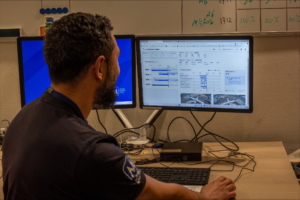
Image: Menzies/Schiphol

Clean & Tidy

The second application tackles a different part of airport operations. Schiphol’s Clean & Tidy initiative uses passenger-flow and facilities data to help cleaning companies decide how to deploy staff and maintain quality across the terminal.

One challenge is Schiphol Plaza, a shared space that does not fit neatly into traditional airport passenger forecasting. “The place they pass through is a shopping mall and it’s also a train station,” Schoenmaker says. “So it’s not just an airport-specific spot.”

Schiphol had historically begun tracking departing passengers from the check-in desks, after they had moved through the Plaza. The airport therefore developed forecasts for how busy the area would become. These feed into the Smart Facilities Dashboard, which brings together passenger flows, cleaning activity and quality measures to help contractors schedule staff.

Unlike Deep Turnaround, the approach does not require a new layer of cameras or dedicated hardware. It makes greater use of data already available across the airport and its partners. For Schoenmaker, the focus also reflects how quickly passengers form an impression of an airport. “From a cleanliness perspective, Plaza is very important,” she says. “It makes first impressions really important.”

Passenger feedback buttons provide one measure of performance. Schiphol reports that its overall quality indicator has risen by 12 percent since the Clean & Tidy initiative began, with the Smart Facilities Dashboard a key contributor. The figure covers the broader initiative rather than isolating the effect of AI forecasting.

The next phase is intended to connect forecasts more closely with cleaning hours, expected quality and costs. Schiphol’s work is still being developed with contractors, with current examples using dummy data rather than operational results.

The two projects operate in very different environments, but both show the importance of getting predictions to the people able to act on them. For Stroop, that practical impact ultimately determines whether the technology becomes useful in day-to-day operations.

“The moment staff see they can do something with it, is when they see it actually makes an impact on their work.”


Want to go deeper on airport AI?

Annemijn Schoenmaker also features in the Airports AI Alliance Playbook: How to Deploy Artificial Intelligence to Transform Airport Operations, sharing practical insights from Schiphol alongside airport leaders and AI experts.

The Playbook explores how airports can move from AI experimentation to real-world deployment, with guidance and case studies covering operations, passenger experience and infrastructure.

The full Playbook is available exclusively to Airports AI Alliance members.

Main image: Menzies/Schiphol

AirportLabs expands airport software offering into Asia

AirportLabs is targeting airport operators across Asia with software that connects operational data, resource allocation and passenger information. The expansion covers its full product range, although the company has not named new customers in the region or announced deployment dates.

The aviation software supplier says its products are used at more than 100 airports, including Dubai International, London Heathrow and Chicago O’Hare (pictured). It is seeking business from individual airports and operators managing multiple sites, drawing on previous deployments across airport networks in Europe and the Americas.

“Small airports need to run the same code as our largest customers. Not a lite edition, not a legacy fork,” said Ligiu Uiorean, Director, AirportLabs. “Fair pricing is not a discount. It is an architectural outcome.”

The offering includes an airport operational database, resource management software and flight information displays. Other tools cover billing, ground handling, passenger queues and communication between airport teams, with operators able to introduce individual systems rather than replace their entire software estate at once.

The resource management system allocates stands, gates, baggage belts and check-in counters, while a separate monitoring platform gives operations control centres information about upcoming activity. Alerts can be directed to relevant teams, supporting coordination between airports, airlines and ground handlers.

AirportLabs develops its products in-house and delivers them through a cloud-native platform. The company says this reduces reliance on on-site servers and allows airports of different sizes to use the same software.

Its existing group deployments include work with VINCI Airports and OMA, which operates 13 airports in Mexico. Fraport Greece also introduced the company’s Airport Community App across its 14 regional airports in less than four months, according to AirportLabs.

Implementation times vary by project. The company reported a 40-day deployment of its flight information display system at Chihuahua Airport in Mexico, compared with seven months for its operational database and resource management systems at Chicago O’Hare.

These projects involved different systems and scopes, limiting direct comparisons between the reported timelines. The announcement did not specify the integration work, training or changes to operating procedures required at each location.

For operators managing several airports, the proposed approach would bring operational information from different sites into a common system, allowing headquarters to monitor activity across the network.

Airports AI Alliance contacted AirportLabs for details on its priority Asian markets and plans to support local deployments but had not received a response at the time of publication.

Image: 4kclips | Dreamstime.com

MSP moves airport operations onto private 5G

Minneapolis–Saint Paul International Airport (MSP) has become one of the first US airports to move operational systems traditionally dependent on wired connections onto a private 5G network, enabling uninterrupted video, data and communications from vehicles and equipment moving across its airfield and terminals.

The Ericsson network covers the airport’s 13-square-kilometre campus and will support safety and operational systems including cameras, ticketing equipment, connected vehicles and mobile devices. MSP handled more than 342,000 aircraft movements and 36 million passengers in 2025.

Bill Boyd, Director of Infrastructure and Operations for the MAC IT Department

“Private cellular allows us to provide secure, high-speed, low-latency connectivity to in-motion use cases like vehicles and trams [passenger trains connecting airport facilities] across our campus,” Bill Boyd, Director of Infrastructure and Operations for the Metropolitan Airports Commission (MAC) IT Department, told the Airports AI Alliance. “Wi-Fi cannot handle coverage, motion or distance as well as cellular.”

An initial use case provides continuous access to live video from moving airport trams. MAC, which owns and operates MSP, plans to connect further applications as it expands the network.

The network also allows mobile workers in connected airfield vehicles to use paperless work-order systems and communicate in real time throughout the airport. MAC is exploring how it could support closer monitoring of aircraft activity at gates.

“We’re testing new platforms that use private 5G-connected video feeds to analyse gate activity in real time to keep our terminal operations teams proactively informed,” Boyd said. “Improving turn performance through predictive analytics has positive impacts that ultimately improve passenger experience.”

Installing additional fibre would be expensive, while the use of managed spectrum helps protect the cellular network from the interference that can affect Wi-Fi performance.

“Since cellular runs on managed spectrum, we do not experience interference, and our performance across the airfield has been great,” Boyd said.

The airport expects applications involving AI, automation and real-time data analysis to benefit from the network’s speed, low latency and additional security. These capabilities could help teams identify developing operational issues and respond before they affect passengers.

MAC has initially concentrated on internal applications but has begun discussing network access with airlines and other airport partners. Concessionaires could also eventually use the infrastructure.

Boyd said providing private 5G would be a natural extension of the wired connectivity, surveillance and access-control services MAC already supplies to organisations operating at MSP. The commission is consulting aviation and technology specialists as it develops arrangements to expand partner access securely and at scale.

Images: Metropolitan Airports Commission