Tag Archive for: airport AI

How Schiphol is using AI from turnarounds to cleaning

Amsterdam Airport Schiphol handles around 70 million passengers a year through a terminal designed for about 50 million. With major renovation and renewal projects not expected to create additional capacity until around 2034, the airport, like many across the world, is looking at how technology can help it make better use of existing space and resources.

Its technology programme is focused on three areas: passenger experience, capacity, and labour productivity. Annemijn Schoenmaker, Head of Business Platform Infrastructure & IT Projects within Digital & Technology at Royal Schiphol Group, says those priorities increasingly overlap as the airport deals with constraints on space and people.

Annemijn Schoenmaker, Head of Business Platform Infrastructure & IT Projects within Digital & Technology at Royal Schiphol Group

“We have these scarcities, like scarcity of capacity, scarcity of labour, scarcity of environmental resources,” she tells the Airports AI Alliance. “And then we have all these business processes which may be affected by one of these scarcities or more. Wherever there’s a perfect combination of both having a capacity scarcity and the labour scarcity, then we try and solve those problems with technology.”

Schiphol organises applied technology around its infrastructure, commercial and operations businesses, keeping development tied to operational needs. While it builds some systems itself, Schoenmaker says the airport is increasingly looking outside where suitable technology already exists.

“We prefer a fast follower approach right now rather than first mover,” she says. “So we try and increase collaborations also with external specialist parties. They might have LLMs developed already, for example, that we can adopt.”

Deep Turnaround

One area where Schiphol has developed its own technology was aircraft turnaround. The project began in 2018, when the airport had extensive information about arriving and departing flights but much less visibility over activity at the stand.

“We had all the data from inbound flights and outbound flights,” says Marcel Stroop, Director of Go-To-Market at Schiphol Group. “We had all the data from passengers, what’s happening in terminal, but what was happening during the turnaround was a complete black hole.”

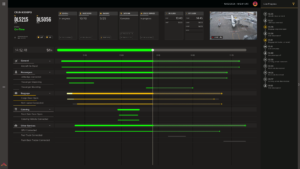
Cameras around aircraft stands capture refuelling, catering and pushback activities with computer vision converting the images into operational events. By 2023, the system had evolved beyond monitoring to forecasting when processes would finish, when an aircraft would be ready to depart and whether delays could create gate conflicts.

“A prediction doesn’t really do anything because a prediction doesn’t move an aircraft,” says Stroop. “So how could we actually make sure that the person that needed to act on this prediction does something?”

That shifted the focus towards what Stroop calls “coordinated action”, getting information to airlines, ground handlers, gate planners and other partners in forms they could use. Integration was complicated by strict aviation rules governing where information comes from and who can enter it, while existing data standards were not designed for all the new events being generated.

Deep Turnaround was developed by an in-house product team within Digital & Technology, with operational teams setting the requirements. Local partners can support elements such as hardware installation. Investment sits within Schiphol’s wider technology portfolio, backed by an operational business sponsor, and competes with other technology priorities for funding.

While Deep Turnaround was developed and deployed at Schiphol, the airport also saw potential for its predictions to be used beyond its own operations. Discussions with Eurocontrol, the pan-European organisation that helps coordinate air traffic management across the region, began around 2019. This led to a separate pilot at Eindhoven Airport between June and August 2026, testing how Deep Turnaround predictions could be incorporated into Eurocontrol’s air traffic management processes.

Marcel Stroop, Director of Go-To-Market at Schiphol Group

Stroop gives the example of an aircraft completing its turnaround and being ready to leave, only to sit at the airport with passengers on board for another 20 minutes because its allocated take-off slot has not been given. Better predictions of when aircraft are ready could give Eurocontrol more accurate information when managing those slots.

Schiphol had expected its predictions to run in the background during the Eindhoven trial, alongside Eurocontrol’s existing system. Instead, Stroop says Eurocontrol used the model incorporating Deep Turnaround predictions live and ran its existing approach in shadow mode. He says the pilot cut waiting time by a “considerable amount of minutes”, although the precise figure was not available for publication.

In Amsterdam, adoption depended on operating partners and frontline employees seeing a practical benefit. Stroop says the airport initially assumed that the national carrier KLM would be central to adoption because of the number of flights it operates out of Schiphol. Instead, the team began with smaller airlines and easyJet, for example, together with its ground handler, became strong supporters of the technology.

Schoenmaker adds that helped build momentum with the larger operators. “You kind of create a bit of competition,” she says. “Prove it, get a bit of the jealousy going, and then the big ones adopt it.”
For employees on the apron, the benefits also had to be tangible. A tow-truck driver, for example, may previously have been allocated to an aircraft set well in advance.

“In the old situation, they would do that based on a timestamp which was set a week ago,” Stroop says. “So the tow truck would just sit there idle, sometimes for 20 minutes, not doing anything because the plane was not ready yet.”

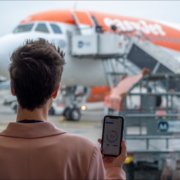
Live information on smart watches, phones or tablets lets the driver see whether another aircraft is ready sooner and change the sequence.

“All of a sudden, [the driver] does two pushbacks in, for example, 10 minutes instead of one,” Stroop says. “That’s where you really see them say, ‘Oh wow, it also improved my own work.’”

The interface was deliberately kept basic for employees already working under complex airside safety requirements. “It’s really about keeping it as simple as possible. Less is more,” says Stroop.

Deep Turnaround has achieved a 3.6 percent improvement in on-time performance at Schiphol according to Stroop, alongside an 11 percent reduction in missed runway slots. Schiphol began commercialising the technology in 2023, allowing other airports to deploy it while feeding lessons back into the product.
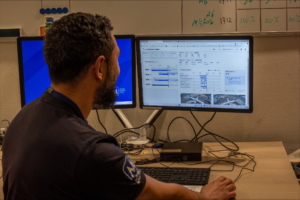
Image: Menzies/Schiphol

Clean & Tidy

The second application tackles a different part of airport operations. Schiphol’s Clean & Tidy initiative uses passenger-flow and facilities data to help cleaning companies decide how to deploy staff and maintain quality across the terminal.

One challenge is Schiphol Plaza, a shared space that does not fit neatly into traditional airport passenger forecasting. “The place they pass through is a shopping mall and it’s also a train station,” Schoenmaker says. “So it’s not just an airport-specific spot.”

Schiphol had historically begun tracking departing passengers from the check-in desks, after they had moved through the Plaza. The airport therefore developed forecasts for how busy the area would become. These feed into the Smart Facilities Dashboard, which brings together passenger flows, cleaning activity and quality measures to help contractors schedule staff.

Unlike Deep Turnaround, the approach does not require a new layer of cameras or dedicated hardware. It makes greater use of data already available across the airport and its partners. For Schoenmaker, the focus also reflects how quickly passengers form an impression of an airport. “From a cleanliness perspective, Plaza is very important,” she says. “It makes first impressions really important.”

Passenger feedback buttons provide one measure of performance. Schiphol reports that its overall quality indicator has risen by 12 percent since the Clean & Tidy initiative began, with the Smart Facilities Dashboard a key contributor. The figure covers the broader initiative rather than isolating the effect of AI forecasting.

The next phase is intended to connect forecasts more closely with cleaning hours, expected quality and costs. Schiphol’s work is still being developed with contractors, with current examples using dummy data rather than operational results.

The two projects operate in very different environments, but both show the importance of getting predictions to the people able to act on them. For Stroop, that practical impact ultimately determines whether the technology becomes useful in day-to-day operations.

“The moment staff see they can do something with it, is when they see it actually makes an impact on their work.”


Want to go deeper on airport AI?

Annemijn Schoenmaker also features in the Airports AI Alliance Playbook: How to Deploy Artificial Intelligence to Transform Airport Operations, sharing practical insights from Schiphol alongside airport leaders and AI experts.

The Playbook explores how airports can move from AI experimentation to real-world deployment, with guidance and case studies covering operations, passenger experience and infrastructure.

The full Playbook is available exclusively to Airports AI Alliance members.

Main image: Menzies/Schiphol
Zurich Airport removes drivers from automated shuttles

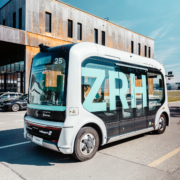
Zurich Airport has begun operating two Level 4 automated shuttle buses without onboard safety drivers following more than 15,000 kilometres of testing.

The vehicles have operated fully autonomously on a defined three-kilometre route since early September, monitored by staff in a remote cockpit. The shuttles transport airport employees but do not cross aircraft taxiways.

The milestone follows an 18-month pilot undertaken with autonomous driving technology provider WeRide. Testing focused on the technical, operational and regulatory demands of deploying automated vehicles in an airport environment.

Raphaël Glaesener, Senior Innovation Manager at Zurich Airport, told the Airports AI Alliance that the vehicles had to learn to navigate apron-specific situations, including interactions with aircraft pushback vehicles, baggage transports pulling multiple trailers and other priority vehicles.

Raphaël Glaesener, Senior Innovation Manager at Zurich Airport

“At the same time, the project had to meet extensive regulatory and safety requirements before operations without an onboard safety driver could begin,” he said.

Former safety drivers have been trained to monitor the buses remotely. One operator currently oversees one vehicle at a time and can provide guidance in exceptional circumstances, but does not drive it remotely.

Cases where the automated driving system could respond more effectively are documented and passed to WeRide to inform further development. Zurich Airport aims to reduce the frequency with which remote operators must provide support as the technology matures.

“This phase allows us to further improve the system,” Glaesener said. “The aim is to continuously reduce the need for support from the remote cockpit as the technology matures.”

Zurich Airport has not set a target for how many buses each employee could eventually monitor, although higher ratios are technically possible. Achieving them would require the automated driving system to manage increasingly complex airport situations without assistance.

“For Zurich Airport, one of the main reasons for exploring this technology is its potential to address the growing shortage of skilled workers,” Glaesener said. “The pilot project allows us to gain practical experience and assess where automated vehicles can meaningfully support airport operations in the future.”

Each stage of the trial has begun without passengers before employees were permitted to use the service. The first Level 4 journeys are following the same process, with staff expected to begin travelling on the driverless shuttles after approximately four weeks of testing.

The two-bus pilot is scheduled to continue until the end of 2026. Zurich Airport and its project partners are considering a possible extension and assessing other potential applications.

“We are currently evaluating potential future applications, but no decisions have yet been made regarding specific routes or use cases beyond the current pilot,” Glaesener said.

Main image: Zurich Airport

Airports urged to price AI by outcomes

Airports should consider linking artificial intelligence expenditure and supplier payments more closely to measurable operational results, according to AWS, as the sector moves from experimentation towards larger deployments.

The approach could change how airports build business cases for AI, shifting attention from licences, computing consumption and project costs towards the value delivered. Instead of simply recording how much a system costs, an airport could calculate the amount spent for each minute removed from passenger queues, each disruption resolved more quickly or each additional passenger movement accommodated.

Bob Kwik, Worldwide Head of Airports and Ground Transportation at AWS

“Cost per outcome is not only applicable to airports, it’s arguably more important for airports because so many of the benefits are non-revenue,” Bob Kwik, Worldwide Head of Airports and Ground Transportation at AWS, told the Alliance.

“The key insight is that the ‘outcome’ doesn’t have to be revenue. It can be any measurable business result: passenger throughput at a checkpoint, minutes saved in disruption recovery, safety incidents avoided, or gate utilisation percentage.”

AWS defines cost per outcome as the total cost of an AI deployment divided by a measurable business value metric. The figure is not itself a complete measure of return on investment but provides a basis for comparing expenditure with the operational or financial value created.

For airports, the model offers a way to quantify projects whose benefits do not directly generate revenue. Passenger satisfaction, resilience and safety improvements can be difficult to represent in a conventional financial case, even when they support important organisational objectives.

An airport could measure the cost of every point of improvement in passenger satisfaction or minute removed from average processing times. A disruption-management system could be assessed against the reduction in recovery time, while an AI capacity tool could be measured by the additional movements enabled without new infrastructure.

“This framing makes the CFO conversation easier, not harder, because it directly connects AI spend to the KPIs the airport is already reporting on,” Kwik said. “The critical point is to establish a pre-AI baseline for each metric before deployment. Without a baseline, you can’t demonstrate movement.”

The idea also has implications for procurement. AWS is advocating a wider shift from fixed-cost contracts towards outcome-based pricing, under which payments to technology providers are tied to agreed results.

This would transfer some financial risk from airports to suppliers and give providers a stronger incentive to improve systems after deployment. Airports could test different solutions and expand them according to demonstrated value, rather than committing substantial budgets based mainly on promised capabilities.

However, airports and suppliers must agree outcomes that are measurable, attributable to the technology and difficult to manipulate. Queue times can be influenced by staffing, passenger volumes and airline schedules as well as AI. Safety improvements may be valuable but difficult to attribute to one system, particularly when incidents are already rare.

The cost side can be equally complicated. Model fees or software licences may represent only a fraction of the expenditure associated with an airport AI application.

Airports must also consider data storage and retrieval, connections to operational systems, monitoring, governance, cybersecurity and the staff needed to prepare data and maintain the system. AI agents completing multi-stage tasks can generate additional costs by repeatedly calling external applications.

Real-time airport data is a particular concern. An application may rely on information from an airport operational database, airlines, weather services, sensors and third-party providers. The cost of moving and processing this data can exceed the cost of running the AI model itself.

“For airports with real-time operational data, this integration layer can easily exceed the AI inference cost itself,” Kwik said.

He recommends auditing feeds before connecting them to an AI application. A system may not require second-by-second information if updates every minute would produce the same result at a lower cost. Data-pipeline expenditure should also be included in the initial business case.

Airports will also need to distinguish between different forms of AI. Employee productivity tools normally have predictable per-user subscription costs, while AI embedded in operational software is generally covered through supplier contracts. Bespoke models and agentic systems are more likely to generate variable charges based on tokens, computing requirements and data consumption.

“These categories have distinct differences in budget governance, ROI calculations, and cost visibility, and mixing these three categories into a single ‘AI budget’ line is a recipe for confusion, both when costs spike and when stakeholders ask what they’re getting for the money,” Kwik said.

The assessment period will vary. Kwik suggests productivity tools can begin to show adoption patterns within two or three months. AI embedded in an operational application may need to be evaluated across an entire IATA season, while bespoke projects may require three to six months, supported by monthly reviews.

A falling cost per outcome may support expansion, while rising costs without improved performance could indicate that the model, data pipeline or project scope needs to change.

Outcome-based pricing will not remove the uncertainty surrounding airport AI investment. It could, however, give airport technology and finance teams a clearer basis for deciding which projects to scale, redesign or stop, while retaining the flexibility to adopt more effective models as the market develops.

“The simple answer is pick the right model for the task, and build flexibility into the solution so you’re not locked-in to a specific model,” Kwik said.

Main image: 1000words| Dreamstime.com

Boston Logan pilots AI passenger assistant

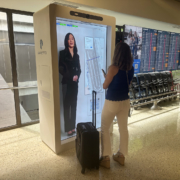
Boston Logan International Airport has introduced a life-size AI assistant to help passengers navigate the terminal and access live travel information.

Named Amelia, the avatar can hold natural-language conversations and provide step-by-step directions to gates, restaurants, shops, lounges and baggage reclaim. The pilot expands the customer service options available to passengers at the airport.

The assistant is presented through self-contained units combining a holographic display with a touchscreen. Live mapping and real-time Transportation Security Administration (TSA) updates allow passengers to check security wait times and plan their journeys through the terminal.

“It takes bold vision to implement emerging technologies like holograms and AI avatars, innovations that still feel like science fiction to most people,” said David Nussbaum, Founder of Proto Hologram. “But Massport understands that the technology is ready now, and that it can create a smoother and more pleasant experience at Boston Logan while also supporting the human staff so they can do their best too.”

Amelia can communicate in up to 40 languages, with English, Spanish and French included in the initial service. Accessibility features include high-contrast displays, closed captions, wheelchair-accessible positioning and maps designed to meet Web Content Accessibility Guidelines.

Passengers who need further assistance can also use the system to connect directly with a member of the airport’s customer service team.

The Massachusetts Port Authority (Massport), which owns and operates Boston Logan, said the technology is intended to supplement the airport’s existing passenger assistance services.

The assistant can handle routine wayfinding enquiries throughout the day and night, support airport staff during busy periods and fill gaps in customer service provision. This could allow employees to concentrate on more complex passenger needs.

The pilot was developed by Massport in partnership with Proto Hologram and Holomedia AI. The companies said Boston Logan is the largest airport to introduce the service for passengers and that it represents Proto’s first major deployment in the Boston area.

At Boston Logan, the pilot combines conversational assistance, airport information and live connections to employees within a single interface, while retaining access to human support when passengers require it.

Image: Proto Hologram

Inside the evolution of airport AI

Long before artificial intelligence entered the mainstream through generative AI, Searidge Technologies was applying computer vision to airport operations.

Now, as the company joins the Airports AI Alliance, Marco Rueckert (pictured), Chief Technology Officer at Searidge, says the evolution of airport AI has been shaped less by breakthroughs in algorithms than by solving practical operational challenges, from aircraft surveillance to turnaround management and airside safety.

“When we started in 2006 it was really about trying to provide visual systems that could provide gap filler enhancement to radars,” Rueckert says.

At the time, airports looking to improve surface surveillance often faced limitations created by new hangars and other infrastructure that blocked radar coverage. Rather than installing additional radar systems, Searidge developed computer vision technology that used cameras to detect aircraft and convert those detections into position data, supplementing existing surveillance systems.

Detecting aircraft from video feeds was far from straightforward. Before advances in machine learning, engineers relied on manually programmed algorithms that identified changes in image brightness before determining whether those changes represented an aircraft.

“We worked with a research institute in Quebec to analyse images and detect aircraft,” Rueckert says. “That was before all these advances of AI. At the time it was very difficult because you ended up doing really complicated, PhD-written algorithms that detected luminance changes in the image.”

Those systems required continual refinement to account for changing light, shadows and seasonal conditions.

“We always ended up having to tune it really differently,” he says. “If there were shadows, if there was moving grass, if it was winter versus summer, we had to spend a lot of time fine tuning it.”

Machine learning transformed the process. Rather than writing increasingly complex rules, engineers could train models using thousands of labelled aircraft images, allowing systems to recognise aircraft across a much wider range of operating conditions.

“When we then got into AI, what we found immediately was that AI was able to abstract a lot of this away from us,” Rueckert says. “You just showed it 1,000 images of an aircraft and then it figured out how to learn what an aircraft is.

“The development cycle to get to that level of system performance was dramatically different. You’re talking orders of magnitude difference between developing the original traditionally programmed expert system versus the AI system.”

One of the company’s early deployments using machine learning was at Fort Lauderdale-Hollywood International Airport, where thermal cameras were used to detect aircraft. Because publicly available thermal image datasets were limited at the time, Searidge developed its own training data to support the deployment.

Today, the company’s work extends well beyond aircraft detection. One of the strongest areas of demand is turnaround management, where computer vision automatically records operational milestones including on-block and off-block times, chocks on and off, safety walks and baggage handling events. The resulting operational data reduces manual reporting while providing airports and airlines with a more accurate picture of aircraft turnarounds.

“We’re seeing quite a lot of strong market demand for turnaround systems,” Rueckert says.

Another area of growth is improving airside safety. Searidge has developed AI systems that analyse aircraft and vehicle movements at service road crossings, using computer vision together with operational data to determine when vehicles can safely cross active taxiways. The systems also account for operational scenarios such as aircraft pushbacks, where jet blast can create additional hazards.

Rueckert says interest in these applications has increased as airports respond to changes in airside operations following the pandemic.

“What we’re doing is applying AI to detect vehicles and aircraft in real time and then making decisions on which traffic lights are going to turn red and which traffic lights are going to turn green,” he says.

As airport AI has matured, conversations with customers have also changed.

“I don’t have to go to airport CTOs anymore and convince them that AI is something that is real,” Rueckert says. “The real challenge now is about return on investment.”

Airport operators increasingly expect AI projects to deliver measurable operational benefits within existing budget cycles while balancing infrastructure costs, computing requirements and energy consumption.

Rueckert believes the next stage of airport AI will depend on engineering discipline as much as advances in artificial intelligence. Systems deployed in operational environments must be able to monitor their own performance, detect faults and respond safely when conditions change, particularly in safety-critical applications.

He also sees a need for greater collaboration across the aviation industry to develop common approaches to deploying AI in operational environments.

For Searidge, joining the Airports AI Alliance reflects that broader direction. Having spent nearly two decades developing computer vision applications for airports, the company is looking to contribute practical experience as airports move beyond AI pilots and focus on deploying operational systems that deliver measurable improvements in efficiency, safety and day-to-day airport performance.

Images: Searidge Technologies