Tag Archive for: Biometrics

London City Airport shifts airline operations to shared cloud platform

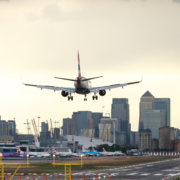
London City Airport has introduced shared cloud-based passenger processing infrastructure as part of a wider technology overhaul designed to increase capacity within its existing terminal building.

The airport has made the Amadeus Airport Cloud Use Service (ACUS) available throughout the terminal, allowing airlines to run their passenger service applications from shared infrastructure rather than relying on fixed, airline-specific desks.

An Amadeus spokesperson told the Airports AI Alliance that integrating multiple airline systems while maintaining normal airport operations is a significant challenge.

“Generally speaking, implementing common-use technology in a live airport is inherently complex,” they said. “It means bringing multiple airlines, systems and operational requirements onto shared infrastructure, while ensuring passenger processing continues securely and reliably throughout the transition.”

The move forms part of an agreement that also includes shared self-service check-in kiosks, automated bag-drop units and biometric processing technology. Passengers will be able to enrol for biometrics once per trip and use the technology during check-in and bag drop, reducing repeated processing steps.

The investment comes as London City works towards an approved annual passenger cap of nine million, with the airport seeking to accommodate additional travellers without expanding its existing terminal. The cloud platform also allows airport staff to serve passengers from different locations rather than being tied to dedicated check-in desks.

The spokesperson said close collaboration between the airport, airlines and technology partners, alongside rigorous testing, is essential to maintaining operational continuity during implementation.

Although the airport expects the wider technology programme to increase passenger throughput, no specific capacity gain has been announced.

“There’s no one-size-fits-all figure, as capacity gain depends on the existing infrastructure, passenger mix, processes and where operational constraints occur,” the spokesperson said.

They also said greater use of self-service allows airport employees to move away from fixed desks and provide more personalised assistance to passengers. The airport is also awaiting approval through an Airspace Change Process to accommodate new-generation aircraft capable of carrying more passengers.

For the technology programme, operational efficiency, flexibility and passenger experience will be the principal measures of success.

Image: Mrcatmint | Dreamstime.com

India trials passport-free checks at seven airports

India has begun trials of its Digi Yatra biometric passenger processing system for international departures at seven airports, ahead of a wider rollout planned for 2027.

The trials, running from November to December, cover Delhi, Bengaluru (pictured), Hyderabad, Cochin, Mumbai, Chennai and Amritsar airports. Eligible Indian nationals holding e-passports can use the technology on selected international flights operated by Air India and IndiGo.

According to India’s Ministry of Civil Aviation, passengers will be able to use facial recognition at participating terminal entrances, security checkpoints and boarding gates, where the necessary infrastructure is available. Feedback gathered during the trials will help determine the next phase of deployment.

At Bengaluru’s Kempegowda International Airport, the initiative builds on a technical proof of concept conducted earlier this year with IATA, IndiGo, SITA and Digi Yatra, which explored integrating secure digital credentials with biometric passenger processing.

George Fanthome, Chief Technical Officer at Bengaluru Airport’s operator, Bangalore International Airport Limited, said: “Through this trial, we are bringing together secure digital identity and face-enabled processing to reduce repeated document checks across participating touchpoints, while building a framework that can evolve and scale with the future needs of international travel.”

Digital credentials

To participate, passengers must create an e-passport-based Verifiable Credential through the Digi Yatra mobile application. This involves scanning the passport’s machine-readable zone, reading its embedded chip using a smartphone’s near-field communication technology and completing selfie verification.

The resulting credential is stored in a digital wallet on the passenger’s device and can be presented at participating airport checkpoints.

However, the trials do not eliminate existing international travel requirements. Passengers must still carry their passports, complete mandatory airline document checks and undergo immigration procedures.

At Bengaluru, the initial deployment covers terminal entry and security, with the potential to extend to boarding on selected international services.

The international expansion follows growing domestic adoption of Digi Yatra, which currently has more than 26.5 million registered users and has facilitated over 110 million passenger journeys across 39 Indian airports.

A further 25 domestic airports are expected to adopt the platform by 2027, alongside the planned wider international rollout. The trials will assess how digital identity technology can streamline airport processing while retaining existing security and border control requirements.

Image: Albin Raj | Dreamstime.com

IATA: Digital travel credentials could transform journeys by 2030

The International Air Transport Association (IATA) has warned that fragmented technology systems and inconsistent government requirements are limiting the benefits of artificial intelligence (AI), biometrics and digital identity across the passenger journey. Despite growing adoption, many systems remain confined to individual airports or countries, preventing passengers from experiencing a fully connected journey.

The warning comes as IATA’s 2026 Global Passenger Survey reveals growing demand for digital services. Almost half (49 percent) of passengers have used AI for travel planning, while 58 percent have experienced biometrics during an airport journey in the past year, up from 50 percent in 2025.

During a media briefing on the survey, joined by the Airports AI Alliance, Nick Careen, IATA Senior Vice President, Operations, Safety and Security, said the industry needed to move beyond isolated deployments.

Nick Careen, IATA Senior Vice President, Operations, Safety and Security

“What we need now, however, is for these things to be interoperable and harmonised,” he said. “Once we get to that point, we will have improved services. We will get the efficiencies we’re looking for. We will have improved security.”

First One ID certifications

In a significant step towards greater interoperability, Air New Zealand and Hong Kong International Airport (HKIA) have become the first organisations to achieve IATA One ID Certification. The certification assesses compliance with global standards covering digital identity, contactless travel, biometric handling and privacy governance.

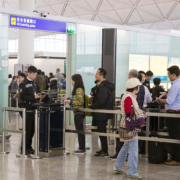
HKIA’s Flight Token biometric identification system has been used by more than 93 million passengers since its introduction in 2021, while more than 80 percent of departing passengers are eligible to use facial recognition across all departure checkpoints.

The milestone comes amid growing public acceptance of biometrics. IATA found that 78 percent of passengers would share biometric information to avoid repeated document checks, although 59 percent remain concerned about data breaches.

Jeremy O’Brien, Chief Customer & Digital Officer, Air New Zealand, said the airline’s trial with HKIA demonstrated the potential for cross-border digital identity.

“Our trial with Hong Kong International Airport showed how digital identity could work across borders, reducing the need for documentation and queuing, but it also showed that customers can trust us to keep their information safe,” he said.

Government barriers

Despite technological progress, Careen identified government regulation and inconsistent immigration processes as major obstacles to delivering seamless international journeys. He described his own experiences of online visa applications, including problems with photograph specifications, incompatible files and systems freezing midway through applications.

“They needed to know what I had for breakfast 10 years ago, but you know what? What really worked consistently in all cases is the payment,” he said.

The survey found that 43 percent of passengers had been discouraged from visiting a destination because of immigration requirements, compared with 33 percent in 2025. Careen said the technology needed to address these problems already existed, but governments had to adopt consistent standards.

“So eVisa is the answer, but what it takes is standardisation and consistency. We have it in over 100 countries right now, but too many variations,” he said.

Asked when passengers could realistically expect an internationally interoperable digital journey, Careen suggested meaningful adoption could emerge between now and 2030, with Europe potentially leading through digital travel credentials. IATA has conducted several cross-border proofs of concept, but regulatory restrictions and privacy concerns continue to prevent widespread deployment.

Careen said the trials had demonstrated that digital identity could work between countries, but government regulations still needed to change to allow wider implementation. He also identified data privacy as an obstacle, estimating that meaningful, consistent use of digital travel credentials across international borders could emerge within the next three to five years.

Main image: Valentin M Armianu | Dreamstime.com

Facial recognition replaces passport scanning at UK eGates

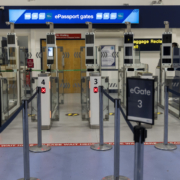
The UK has begun rolling out contactless eGates that allow arriving passengers to clear border controls using facial recognition without presenting their passport.

The system captures a live image of a passenger approaching the eGate and checks it against verified immigration, travel and passport information. If the checks are completed successfully, the gate opens without the passenger placing their passport on a reader.

“By using state-of-the-art technology, we are making journeys smoother and faster, all while fully maintaining the UK’s robust border security,” said Phil Douglas, Director General of Border Force.

Testing by Border Force found the contactless process can be up to 25 percent faster than using a passport at an eGate. Every UK airport eGate is expected to be upgraded by early 2027.

The phased deployment has started at East Midlands Airport, initially for British citizens, and will expand to other airports and nationalities already eligible to use eGates over the coming months.

Mike Grimes, Customer Services and Planning Director at East Midlands Airport, told the Airports AI Alliance that the introduction had required no changes to the airport’s existing eGate hardware or layout.

Mike Grimes, Customer Services and Planning Director at East Midlands Airport (c) EMA

“The new e-gates remain in the same location as before in the immigration hall, as this was a software upgrade rather than new hardware,” he said. “We have however made changes to our wayfinding and to the look and feel of the hall with new panelling and local tourist hotspot pictures, which along with the new e-gates creates an overall improvement for passengers arriving at East Midlands Airport.”

Grimes said collaboration with Border Force, alongside staff training and support, had been important in ensuring a smooth transition.

The airport is also using automation in other parts of the passenger journey, including parking, security and passenger information services.

“While contactless is one way of improving the experience, we find that automation in many forms helps us,” Grimes said. “We have introduced self-serve kiosks in our Meet & Greet operations, new automated boarding pass scanners at security and a virtual assistant at touch-screen information kiosks in the departure lounge to answer our customer questions–all of which make things quicker and easier for our customers.”

The phased rollout will extend to 12 other airports, including Heathrow, Gatwick, Manchester, Birmingham and Edinburgh, with all UK airport eGates expected to be upgraded by early 2027.

Passengers will still need to carry their passports. If additional checks are required, they may be asked to place their passport on the reader or be directed to a Border Force officer, while officers will continue to monitor the eGates and provide assistance.

The deployment follows the extension of eGate eligibility to children aged eight and above and forms part of the government’s wider programme to digitise the UK border, which also includes the Electronic Travel Authorisation scheme.

Main image: Border Force