

Tag Archive for: Metropolitan Airports Commission

Minneapolis airport operator appoints AI director

The Metropolitan Airports Commission (MAC), which operates Minneapolis-St. Paul International Airport and six general aviation airports, has appointed Nick Running (pictured) as Assistant Director of Data and Artificial Intelligence as it expands its use of emerging technologies.

Running will lead the organisation’s enterprise data practice, including geographic information systems (GIS), and help establish governance and policies for the adoption of AI across airport operations.

“The role will help the organisation govern beyond current capabilities with an outlook for how we engage with new tools and data in the future,” Eduardo Valencia, MAC’s Chief Information Officer and President of the Airports AI Alliance, told AAA.

“Nick will lead us to adopt AI-specific governance and policies that enable the safe and efficient use of AI systems to maximise their capabilities.”

The appointment comes as MAC explores how AI can improve operational efficiency, passenger services and infrastructure planning across its airport system. Valencia confirmed that the organisation already has AI proofs of concept underway, targeting operational challenges and longer-term decision-making.

“There are tremendous opportunities to use AI across the airport ecosystem: predicting maintenance needs, matching resources to passenger demand from curb to gate, making security and accessibility work better for travellers and using data to sharpen concessions and customer feedback,” he said.

“We have proofs of concept to utilise AI underway to address core airport business problems and the long-range planning analysis that can help better guide our operations for decades.”

The initiatives highlight MAC’s efforts to use AI to improve resource allocation, infrastructure management and the passenger experience.

Running brings more than 20 years of experience in data, analytics and technology, having previously worked across corporate travel, healthcare, agriculture and software services. Most recently, he was Manager of Data Engineering at GovDocs, following leadership roles at CHS Inc., UnitedHealth Group and Ecolab.

His responsibilities will also include strengthening MAC’s enterprise data capabilities and supporting the development of more connected and reliable information systems. The appointment is intended to provide the governance and technical foundations needed to support wider AI adoption across the airport system.

Image: MAC
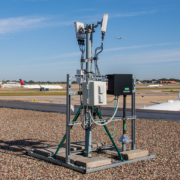
MSP moves airport operations onto private 5G

Minneapolis–Saint Paul International Airport (MSP) has become one of the first US airports to move operational systems traditionally dependent on wired connections onto a private 5G network, enabling uninterrupted video, data and communications from vehicles and equipment moving across its airfield and terminals.

The Ericsson network covers the airport’s 13-square-kilometre campus and will support safety and operational systems including cameras, ticketing equipment, connected vehicles and mobile devices. MSP handled more than 342,000 aircraft movements and 36 million passengers in 2025.

Bill Boyd, Director of Infrastructure and Operations for the MAC IT Department

“Private cellular allows us to provide secure, high-speed, low-latency connectivity to in-motion use cases like vehicles and trams [passenger trains connecting airport facilities] across our campus,” Bill Boyd, Director of Infrastructure and Operations for the Metropolitan Airports Commission (MAC) IT Department, told the Airports AI Alliance. “Wi-Fi cannot handle coverage, motion or distance as well as cellular.”

An initial use case provides continuous access to live video from moving airport trams. MAC, which owns and operates MSP, plans to connect further applications as it expands the network.

The network also allows mobile workers in connected airfield vehicles to use paperless work-order systems and communicate in real time throughout the airport. MAC is exploring how it could support closer monitoring of aircraft activity at gates.

“We’re testing new platforms that use private 5G-connected video feeds to analyse gate activity in real time to keep our terminal operations teams proactively informed,” Boyd said. “Improving turn performance through predictive analytics has positive impacts that ultimately improve passenger experience.”

Installing additional fibre would be expensive, while the use of managed spectrum helps protect the cellular network from the interference that can affect Wi-Fi performance.

“Since cellular runs on managed spectrum, we do not experience interference, and our performance across the airfield has been great,” Boyd said.

The airport expects applications involving AI, automation and real-time data analysis to benefit from the network’s speed, low latency and additional security. These capabilities could help teams identify developing operational issues and respond before they affect passengers.

MAC has initially concentrated on internal applications but has begun discussing network access with airlines and other airport partners. Concessionaires could also eventually use the infrastructure.

Boyd said providing private 5G would be a natural extension of the wired connectivity, surveillance and access-control services MAC already supplies to organisations operating at MSP. The commission is consulting aviation and technology specialists as it develops arrangements to expand partner access securely and at scale.

Images: Metropolitan Airports Commission