Tag Archive for: airport technology

DFW to establish dedicated AI leadership role

Dallas Fort Worth International Airport (DFW) is creating a senior artificial intelligence position to coordinate AI adoption across its operations, as it seeks to strengthen governance and expand the technology’s use.

The principal AI lead will oversee strategy, infrastructure, procurement and employee training, according to a report by Dallas Innovates. Responsibilities will include managing pilot projects, evaluating emerging technologies and establishing safeguards against unauthorised AI use.

A DFW spokesperson told Dallas Innovates that the position would support efforts to improve operational efficiency, passenger experience and employee productivity.

Paul Puopolo, Executive Vice President and Chief Technology and Innovation Officer at DFW

The AI lead will work alongside Paul Puopolo, Executive Vice President and Chief Technology and Innovation Officer at DFW and founding president of the Airports AI Alliance (AAA). Puopolo remains on the Alliance’s Executive Committee following the appointment of Eduardo Valencia, Chief Information Officer at the Metropolitan Airports Commission (MAC), as president in August.

When AAA was established in 2024, Puopolo emphasised the importance of collaboration between airport business and technology leaders to integrate AI with existing systems. The new position at DFW represents a further step towards putting that approach into practice across the organisation.

The move follows MAC’s recent appointment of Nick Running as Assistant Director of Data and Artificial Intelligence. Running is responsible for strengthening enterprise data management and developing governance policies to support AI adoption across MAC’s airport system.

In an earlier interview with AAA, Valencia emphasised the importance of workforce development and data readiness, arguing that airports should prioritise AI applications addressing clearly defined operational challenges.

The new position forms part of DFW’s wider efforts to develop a technology roadmap for the next decade, with greater coordination of AI deployment across the organisation.

Main image: Rob Atherton | Dreamstime.com

Minneapolis airport operator appoints AI director

The Metropolitan Airports Commission (MAC), which operates Minneapolis-St. Paul International Airport and six general aviation airports, has appointed Nick Running (pictured) as Assistant Director of Data and Artificial Intelligence as it expands its use of emerging technologies.

Running will lead the organisation’s enterprise data practice, including geographic information systems (GIS), and help establish governance and policies for the adoption of AI across airport operations.

“The role will help the organisation govern beyond current capabilities with an outlook for how we engage with new tools and data in the future,” Eduardo Valencia, MAC’s Chief Information Officer and President of the Airports AI Alliance, told AAA.

“Nick will lead us to adopt AI-specific governance and policies that enable the safe and efficient use of AI systems to maximise their capabilities.”

The appointment comes as MAC explores how AI can improve operational efficiency, passenger services and infrastructure planning across its airport system. Valencia confirmed that the organisation already has AI proofs of concept underway, targeting operational challenges and longer-term decision-making.

“There are tremendous opportunities to use AI across the airport ecosystem: predicting maintenance needs, matching resources to passenger demand from curb to gate, making security and accessibility work better for travellers and using data to sharpen concessions and customer feedback,” he said.

“We have proofs of concept to utilise AI underway to address core airport business problems and the long-range planning analysis that can help better guide our operations for decades.”

The initiatives highlight MAC’s efforts to use AI to improve resource allocation, infrastructure management and the passenger experience.

Running brings more than 20 years of experience in data, analytics and technology, having previously worked across corporate travel, healthcare, agriculture and software services. Most recently, he was Manager of Data Engineering at GovDocs, following leadership roles at CHS Inc., UnitedHealth Group and Ecolab.

His responsibilities will also include strengthening MAC’s enterprise data capabilities and supporting the development of more connected and reliable information systems. The appointment is intended to provide the governance and technical foundations needed to support wider AI adoption across the airport system.

Image: MAC

Facial recognition replaces passport scanning at UK eGates

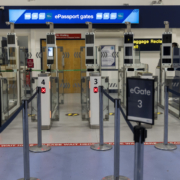
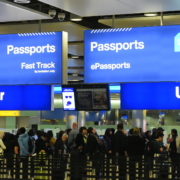
The UK has begun rolling out contactless eGates that allow arriving passengers to clear border controls using facial recognition without presenting their passport.

The system captures a live image of a passenger approaching the eGate and checks it against verified immigration, travel and passport information. If the checks are completed successfully, the gate opens without the passenger placing their passport on a reader.

“By using state-of-the-art technology, we are making journeys smoother and faster, all while fully maintaining the UK’s robust border security,” said Phil Douglas, Director General of Border Force.

Testing by Border Force found the contactless process can be up to 25 percent faster than using a passport at an eGate. Every UK airport eGate is expected to be upgraded by early 2027.

The phased deployment has started at East Midlands Airport, initially for British citizens, and will expand to other airports and nationalities already eligible to use eGates over the coming months.

Mike Grimes, Customer Services and Planning Director at East Midlands Airport, told the Airports AI Alliance that the introduction had required no changes to the airport’s existing eGate hardware or layout.

Mike Grimes, Customer Services and Planning Director at East Midlands Airport (c) EMA

“The new e-gates remain in the same location as before in the immigration hall, as this was a software upgrade rather than new hardware,” he said. “We have however made changes to our wayfinding and to the look and feel of the hall with new panelling and local tourist hotspot pictures, which along with the new e-gates creates an overall improvement for passengers arriving at East Midlands Airport.”

Grimes said collaboration with Border Force, alongside staff training and support, had been important in ensuring a smooth transition.

The airport is also using automation in other parts of the passenger journey, including parking, security and passenger information services.

“While contactless is one way of improving the experience, we find that automation in many forms helps us,” Grimes said. “We have introduced self-serve kiosks in our Meet & Greet operations, new automated boarding pass scanners at security and a virtual assistant at touch-screen information kiosks in the departure lounge to answer our customer questions–all of which make things quicker and easier for our customers.”

The phased rollout will extend to 12 other airports, including Heathrow, Gatwick, Manchester, Birmingham and Edinburgh, with all UK airport eGates expected to be upgraded by early 2027.

Passengers will still need to carry their passports. If additional checks are required, they may be asked to place their passport on the reader or be directed to a Border Force officer, while officers will continue to monitor the eGates and provide assistance.

The deployment follows the extension of eGate eligibility to children aged eight and above and forms part of the government’s wider programme to digitise the UK border, which also includes the Electronic Travel Authorisation scheme.

Main image: Border Force

Naviq joins AAA to help scale airport AI

Naviq has joined the Airports AI Alliance (AAA), with the recently launched company aiming to help airports make better use of operational data and move artificial intelligence beyond individual trials.

Launched in July as part of IBS Group, Naviq works across legacy system modernisation, cloud migration, operational data and AI, with a particular focus on connecting technologies and information that have traditionally sat in separate systems.

“Airports are modernising their legacy airport technology, and that spans from airport operational databases [AODB] to all kinds of supporting systems, on-prem to cloud migrations and bringing in new state-of-the-art SaaS solutions into their environment,” Kay Hellwig (pictured), Director of Sales, Europe and Africa at Naviq, told the Alliance.

“We help airports to anticipate disruptions rather than just react. How they can make better use of operational data, data and AI is a big topic, and we want to help them move from individual POCs to really an enterprise AI use that brings value to the airport.”

Hellwig highlighted a recent project with a customer that already held the information it needed but struggled to use it effectively because it was spread across different systems.

“The data is scattered across systems,” he said. “We have invested in a platform that accelerates bringing data together using AI.”

According to Hellwig, the customer was able to combine information from different sources three to five times faster than through a conventional data lake development process. Naviq then added pre-built key performance indicators and a platform on which further AI use cases could be developed.

“They’ve used that to create new KPIs that help them steer the business better and make better and faster decisions in their operational day-to-day work,” he said.

Hellwig sees a similar opportunity at an industry level, where operational information is divided between airports, airlines, ground handlers and other organisations.

“Sharing data is important because then you can gain other insights and you can optimise the system overall,” he said.

Greater data exchange with airport retailers could also open up commercial applications, although Hellwig said this would depend on appropriate platforms, a clear benefit for the organisations involved and sufficient trust to share information.

Through its AAA membership, Naviq plans to contribute experience from its work with airports, airlines and ground handlers while learning from deployments across the Alliance’s airport membership.

“It’s about really openly discussing what is happening, what works well, what doesn’t work well, best practice exchange, and that’s where we can contribute with our domain experience,” Hellwig said.

The company also sees the Alliance as an opportunity to test its assumptions about airports’ priorities against the experience of those implementing AI in operational environments.

“While we do a lot of research and we have industry experts, it’s always good to mirror our understanding and our view with the airports and see whether that’s the right thing or where else do we need to look,” Hellwig said.

For Hellwig, the longer-term shift is therefore less about replacing individual systems than changing how airports use technology, data and AI across their operations.

“What will happen is not just product replacements at airports,” he said. “It’s really changing how they work.”

Image: Naviq

AirportLabs expands airport software offering into Asia

AirportLabs is targeting airport operators across Asia with software that connects operational data, resource allocation and passenger information. The expansion covers its full product range, although the company has not named new customers in the region or announced deployment dates.

The aviation software supplier says its products are used at more than 100 airports, including Dubai International, London Heathrow and Chicago O’Hare (pictured). It is seeking business from individual airports and operators managing multiple sites, drawing on previous deployments across airport networks in Europe and the Americas.

“Small airports need to run the same code as our largest customers. Not a lite edition, not a legacy fork,” said Ligiu Uiorean, Director, AirportLabs. “Fair pricing is not a discount. It is an architectural outcome.”

The offering includes an airport operational database, resource management software and flight information displays. Other tools cover billing, ground handling, passenger queues and communication between airport teams, with operators able to introduce individual systems rather than replace their entire software estate at once.

The resource management system allocates stands, gates, baggage belts and check-in counters, while a separate monitoring platform gives operations control centres information about upcoming activity. Alerts can be directed to relevant teams, supporting coordination between airports, airlines and ground handlers.

AirportLabs develops its products in-house and delivers them through a cloud-native platform. The company says this reduces reliance on on-site servers and allows airports of different sizes to use the same software.

Its existing group deployments include work with VINCI Airports and OMA, which operates 13 airports in Mexico. Fraport Greece also introduced the company’s Airport Community App across its 14 regional airports in less than four months, according to AirportLabs.

Implementation times vary by project. The company reported a 40-day deployment of its flight information display system at Chihuahua Airport in Mexico, compared with seven months for its operational database and resource management systems at Chicago O’Hare.

These projects involved different systems and scopes, limiting direct comparisons between the reported timelines. The announcement did not specify the integration work, training or changes to operating procedures required at each location.

For operators managing several airports, the proposed approach would bring operational information from different sites into a common system, allowing headquarters to monitor activity across the network.

Airports AI Alliance contacted AirportLabs for details on its priority Asian markets and plans to support local deployments but had not received a response at the time of publication.

Image: 4kclips | Dreamstime.com

CVG and GATE Alliance agree innovation partnership

Cincinnati/Northern Kentucky International Airport (CVG) and Germany’s GATE Alliance have signed an agreement to help airport technology suppliers test products, reach new markets and work with partners on both sides of the Atlantic.

GATE Alliance is a network of companies that supply technology and equipment to airports. The memorandum of understanding formalises a relationship that began in 2023. It gives GATE members access to CVG’s aviation ecosystem and innovation resources in the US, while connecting CVG partners with the alliance’s network in Germany.

“CVG believes innovation happens when organisations are willing to test ideas in real-world environments and learn from one another,” said Larry Krauter, CEO of CVG Airport. “This partnership creates a new transatlantic pathway for collaboration and strengthens connections between our region and one of the world’s leading aviation markets.”

The organisations plan to establish a joint working group to arrange introductions, technology demonstrations and pilot projects, and explore potential investment opportunities. For suppliers, the aim is to validate emerging technologies in an airport setting, gather operational feedback and assess opportunities to expand into another market.

“CVG has been a valued partner to our members for several years,” said Jens Reinhard, Managing Director of GATE Alliance. “This agreement creates greater opportunities for innovation, knowledge sharing and market access on both sides of the Atlantic.”

The partnership spans airport operations and sectors including advanced mobility, manufacturing and energy technologies. Its proposed activities include demonstrations at CVG and business introductions between companies in the US and Germany. The partners have yet to announce specific technologies or pilot projects under the agreement.

Image: CVG/GATE Alliance

MSP moves airport operations onto private 5G

Minneapolis–Saint Paul International Airport (MSP) has become one of the first US airports to move operational systems traditionally dependent on wired connections onto a private 5G network, enabling uninterrupted video, data and communications from vehicles and equipment moving across its airfield and terminals.

The Ericsson network covers the airport’s 13-square-kilometre campus and will support safety and operational systems including cameras, ticketing equipment, connected vehicles and mobile devices. MSP handled more than 342,000 aircraft movements and 36 million passengers in 2025.

Bill Boyd, Director of Infrastructure and Operations for the MAC IT Department

“Private cellular allows us to provide secure, high-speed, low-latency connectivity to in-motion use cases like vehicles and trams [passenger trains connecting airport facilities] across our campus,” Bill Boyd, Director of Infrastructure and Operations for the Metropolitan Airports Commission (MAC) IT Department, told the Airports AI Alliance. “Wi-Fi cannot handle coverage, motion or distance as well as cellular.”

An initial use case provides continuous access to live video from moving airport trams. MAC, which owns and operates MSP, plans to connect further applications as it expands the network.

The network also allows mobile workers in connected airfield vehicles to use paperless work-order systems and communicate in real time throughout the airport. MAC is exploring how it could support closer monitoring of aircraft activity at gates.

“We’re testing new platforms that use private 5G-connected video feeds to analyse gate activity in real time to keep our terminal operations teams proactively informed,” Boyd said. “Improving turn performance through predictive analytics has positive impacts that ultimately improve passenger experience.”

Installing additional fibre would be expensive, while the use of managed spectrum helps protect the cellular network from the interference that can affect Wi-Fi performance.

“Since cellular runs on managed spectrum, we do not experience interference, and our performance across the airfield has been great,” Boyd said.

The airport expects applications involving AI, automation and real-time data analysis to benefit from the network’s speed, low latency and additional security. These capabilities could help teams identify developing operational issues and respond before they affect passengers.

MAC has initially concentrated on internal applications but has begun discussing network access with airlines and other airport partners. Concessionaires could also eventually use the infrastructure.

Boyd said providing private 5G would be a natural extension of the wired connectivity, surveillance and access-control services MAC already supplies to organisations operating at MSP. The commission is consulting aviation and technology specialists as it develops arrangements to expand partner access securely and at scale.

Images: Metropolitan Airports Commission

Airports urged to price AI by outcomes

Airports should consider linking artificial intelligence expenditure and supplier payments more closely to measurable operational results, according to AWS, as the sector moves from experimentation towards larger deployments.

The approach could change how airports build business cases for AI, shifting attention from licences, computing consumption and project costs towards the value delivered. Instead of simply recording how much a system costs, an airport could calculate the amount spent for each minute removed from passenger queues, each disruption resolved more quickly or each additional passenger movement accommodated.

Bob Kwik, Worldwide Head of Airports and Ground Transportation at AWS

“Cost per outcome is not only applicable to airports, it’s arguably more important for airports because so many of the benefits are non-revenue,” Bob Kwik, Worldwide Head of Airports and Ground Transportation at AWS, told the Alliance.

“The key insight is that the ‘outcome’ doesn’t have to be revenue. It can be any measurable business result: passenger throughput at a checkpoint, minutes saved in disruption recovery, safety incidents avoided, or gate utilisation percentage.”

AWS defines cost per outcome as the total cost of an AI deployment divided by a measurable business value metric. The figure is not itself a complete measure of return on investment but provides a basis for comparing expenditure with the operational or financial value created.

For airports, the model offers a way to quantify projects whose benefits do not directly generate revenue. Passenger satisfaction, resilience and safety improvements can be difficult to represent in a conventional financial case, even when they support important organisational objectives.

An airport could measure the cost of every point of improvement in passenger satisfaction or minute removed from average processing times. A disruption-management system could be assessed against the reduction in recovery time, while an AI capacity tool could be measured by the additional movements enabled without new infrastructure.

“This framing makes the CFO conversation easier, not harder, because it directly connects AI spend to the KPIs the airport is already reporting on,” Kwik said. “The critical point is to establish a pre-AI baseline for each metric before deployment. Without a baseline, you can’t demonstrate movement.”

The idea also has implications for procurement. AWS is advocating a wider shift from fixed-cost contracts towards outcome-based pricing, under which payments to technology providers are tied to agreed results.

This would transfer some financial risk from airports to suppliers and give providers a stronger incentive to improve systems after deployment. Airports could test different solutions and expand them according to demonstrated value, rather than committing substantial budgets based mainly on promised capabilities.

However, airports and suppliers must agree outcomes that are measurable, attributable to the technology and difficult to manipulate. Queue times can be influenced by staffing, passenger volumes and airline schedules as well as AI. Safety improvements may be valuable but difficult to attribute to one system, particularly when incidents are already rare.

The cost side can be equally complicated. Model fees or software licences may represent only a fraction of the expenditure associated with an airport AI application.

Airports must also consider data storage and retrieval, connections to operational systems, monitoring, governance, cybersecurity and the staff needed to prepare data and maintain the system. AI agents completing multi-stage tasks can generate additional costs by repeatedly calling external applications.

Real-time airport data is a particular concern. An application may rely on information from an airport operational database, airlines, weather services, sensors and third-party providers. The cost of moving and processing this data can exceed the cost of running the AI model itself.

“For airports with real-time operational data, this integration layer can easily exceed the AI inference cost itself,” Kwik said.

He recommends auditing feeds before connecting them to an AI application. A system may not require second-by-second information if updates every minute would produce the same result at a lower cost. Data-pipeline expenditure should also be included in the initial business case.

Airports will also need to distinguish between different forms of AI. Employee productivity tools normally have predictable per-user subscription costs, while AI embedded in operational software is generally covered through supplier contracts. Bespoke models and agentic systems are more likely to generate variable charges based on tokens, computing requirements and data consumption.

“These categories have distinct differences in budget governance, ROI calculations, and cost visibility, and mixing these three categories into a single ‘AI budget’ line is a recipe for confusion, both when costs spike and when stakeholders ask what they’re getting for the money,” Kwik said.

The assessment period will vary. Kwik suggests productivity tools can begin to show adoption patterns within two or three months. AI embedded in an operational application may need to be evaluated across an entire IATA season, while bespoke projects may require three to six months, supported by monthly reviews.

A falling cost per outcome may support expansion, while rising costs without improved performance could indicate that the model, data pipeline or project scope needs to change.

Outcome-based pricing will not remove the uncertainty surrounding airport AI investment. It could, however, give airport technology and finance teams a clearer basis for deciding which projects to scale, redesign or stop, while retaining the flexibility to adopt more effective models as the market develops.

“The simple answer is pick the right model for the task, and build flexibility into the solution so you’re not locked-in to a specific model,” Kwik said.

Main image: 1000words| Dreamstime.com

Boston Logan pilots AI passenger assistant

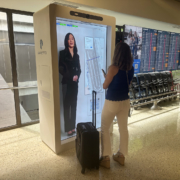
Boston Logan International Airport has introduced a life-size AI assistant to help passengers navigate the terminal and access live travel information.

Named Amelia, the avatar can hold natural-language conversations and provide step-by-step directions to gates, restaurants, shops, lounges and baggage reclaim. The pilot expands the customer service options available to passengers at the airport.

The assistant is presented through self-contained units combining a holographic display with a touchscreen. Live mapping and real-time Transportation Security Administration (TSA) updates allow passengers to check security wait times and plan their journeys through the terminal.

“It takes bold vision to implement emerging technologies like holograms and AI avatars, innovations that still feel like science fiction to most people,” said David Nussbaum, Founder of Proto Hologram. “But Massport understands that the technology is ready now, and that it can create a smoother and more pleasant experience at Boston Logan while also supporting the human staff so they can do their best too.”

Amelia can communicate in up to 40 languages, with English, Spanish and French included in the initial service. Accessibility features include high-contrast displays, closed captions, wheelchair-accessible positioning and maps designed to meet Web Content Accessibility Guidelines.

Passengers who need further assistance can also use the system to connect directly with a member of the airport’s customer service team.

The Massachusetts Port Authority (Massport), which owns and operates Boston Logan, said the technology is intended to supplement the airport’s existing passenger assistance services.

The assistant can handle routine wayfinding enquiries throughout the day and night, support airport staff during busy periods and fill gaps in customer service provision. This could allow employees to concentrate on more complex passenger needs.

The pilot was developed by Massport in partnership with Proto Hologram and Holomedia AI. The companies said Boston Logan is the largest airport to introduce the service for passengers and that it represents Proto’s first major deployment in the Boston area.

At Boston Logan, the pilot combines conversational assistance, airport information and live connections to employees within a single interface, while retaining access to human support when passengers require it.

Image: Proto Hologram