Tag Archive for: airport innovation

Baggage mishandling falls to record low

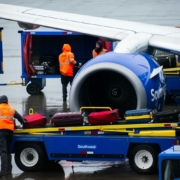
Airlines reduced baggage mishandling to its lowest level on record in 2025, according to SITA’s latest Baggage IT Insights report. The global rate fell to 4.9 mishandled bags per 1,000 passengers – down 23 percent year on year – despite continued growth in passenger traffic.

The report attributes the improvement to wider adoption of digital technologies, including AI-assisted baggage routing, real-time data sharing, biometric bag drop and connected passenger devices. Global passenger numbers reached five billion in 2025, while the total number of mishandled bags fell 19 percent to 24 million.

Despite the progress, baggage mishandling continues to cost the aviation industry an estimated US$6.3 billion annually. SITA estimates the average cost of handling a mishandled bag has risen to US$260, with delayed baggage accounting for around 70 percent of total costs. Transfers remain the leading cause of mishandling, responsible for 39 percent of cases.

“Baggage is shifting from a logistical problem to a digital service,” said Nicole Hogg, Portfolio Director Baggage at SITA. “Passengers expect to know where their bag is at every moment, and they’re increasingly willing to help us track it. The next phase is about bringing the technology we already have to every transfer, every handler and every airport, offering greater visibility and connecting every step of the journey. That’s how the industry earns the trust passengers now expect.”

Looking ahead, the report suggests digital investment will continue to accelerate. Three in four airlines plan to invest in AI over the next two years, while half intend to provide passengers with real-time baggage updates. Industry adoption of baggage tracking under IATA Resolution 753 has also surpassed the 50 percent mark, with full compliance targeted for 2027.


Photo by Jacob Narkiewicz onUnsplash

Former Edmonton CTO joins Alliance to lead data sharing initiative

Tara Mulrooney, former Chief Technology Officer and Vice President of Innovation at Edmonton International Airport, is joining the Airports AI Alliance as Director of Innovation, North America.

Mulrooney brings experience spanning government and critical infrastructure as well as aviation, having also served as CTO at the energy regulator in Alberta from 2011 to 2019.

During her seven years at Edmonton International, she helped lead the Canadian Airport Council‘s work on data sharing, experience she will now bring to the Alliance as it looks to strengthen collaboration across the aviation ecosystem.

“There are siloed agreements between certain airlines and airports, but there isn’t what I’d like to call a minimum data set that is shared to ensure operational efficiency and effectiveness and, where possible, drive additional commercial revenue for all parties,” said Mulrooney.

The AAA Data Sharing Initiative was first discussed at the Alliance’s Summit in Dallas in April.  It will bring together a cohort of airports prepared to share data with each other (and with airlines) to drive measurable benefits in operational and commercial performance.

Mulrooney believes this would also provide airports with greater situational awareness by reducing the number of disconnected information sources used across daily operations.

Her role as Director of Innovation at the Airports AI Alliance will also encompass delivering closer collaboration between airports, the private sector and research institutions.

The Alliance is launching an open innovation programme to help airports move beyond exchanging ideas towards delivering practical projects that can be adopted more widely across the sector.

“I’d love to see the Alliance become known as the place where ideas become action,” she said. “Where airports, industry, academia and governments come together to create solutions that can scale globally.”

Mulrooney sees the airport sector as a proving ground for challenges extending well beyond aviation. If airports can demonstrate how AI, trusted data and cross-sector collaboration improve operational performance, she believes those lessons could be applied across cities, transport networks and other critical infrastructure sectors facing similar digital transformation challenges.

“If we’re helping organisations move from experimentation to implementation, and from discussion to measurable outcomes, we’ll know we’re making a difference.”

In terms of AI adoption, Mulrooney believes that AI will fundamentally change how airports are operated by creating increasingly connected and intelligent operating environments.

“We’re looking at machine-to-machine intelligence and almost a virtual layer on top of an airport,” she said. “Can you operate an airport not just at the physical location, but from a virtual environment or a different location?”

She believes those capabilities could improve resilience during cyberattacks and other disruptive events while allowing airports to respond more quickly to changing operational conditions.

Mulrooney began her role on 1st July and will present the Data Sharing Initiative to the network during virtual sessions and at the upcoming North American Leadership Forum in Atlanta in October.


Tampa airport recognised for AI-powered roadway safety system

Tampa International Airport (TPA) has been named one of 16 global finalists for InnoLead’s 2026 Impact Awards, which recognise organisations delivering measurable innovation across a range of industries.

The airport was recognised for its deployment of an AI- and LiDAR-powered warning system designed to prevent overheight vehicles from entering the airport’s Arrivals and Departures roadways, which is a recurring operational challenge at airports worldwide.

Developed with Sotereon.AI, the Overwatch platform combines five LiDAR sensors with artificial intelligence to detect oversized vehicles before they reach restricted areas. When a vehicle exceeds the height limit, digital signs automatically direct drivers away from the terminal while real-time alerts are sent to airport operations and police teams.

“Overwatch takes data from those sensors and turns it into action,” said Doug Wycoff, TPA’s Director of Digital Technologies & Innovation. “We’ve gone from passive warning signs to a fully managed roadway system that tracks height, volume, and speed.”

According to the airport, the system has detected between 18 and 20 overheight vehicles per day since entering service in April. TPA reported that it has not experienced a single overheight vehicle strike since the deployment went live.

The InnoLead Impact Awards winners were announced on 9 June during the Impact 2026 Conference in Cambridge, Massachusetts.


Photo: Tampa International Airport

Miami Airport to launch airport-wide monitoring hub

Miami International Airport (MIA) has unveiled plans for what it describes as the first airport-wide digital monitoring hub in the United States, bringing together airport operations, emergency response and real-time monitoring in a single facility.

The $33 million facility will feature AI-powered long-range cameras, digital tower technology and an integrated panoramic video wall, providing 360-degree visibility across airside, landside and terminal operations. It will also house representatives from up to 30 agencies, enabling faster coordination during operational disruptions and emergency situations.

Miami-Dade County Mayor Daniella Levine Cava said the project builds on the airport’s existing operational model. “In addition to ranking among the busiest airports in the world, MIA is also a proven industry leader in multi-agency collaboration, integrated airport operations, and incident management,” she said.

The facility is designed to transition seamlessly into an emergency operations centre when required, supported by hurricane-resistant infrastructure, cyber-secure architecture and vibration-controlled platforms.

The new Airport Operations Center forms part of MIA’s $14 billion Modernization in Action programme and is scheduled to open in 2027.


Photo by Ronny Rondon on Unsplash

New survey shows travellers are open to AI assistance

New research from Amadeus suggests travellers are becoming increasingly comfortable with AI tools to support transport and mobility journeys, especially where technology can reduce friction and improve access to real-time information.

The research highlights that travellers are more willing to share personal data when there is a clear operational benefit, such as faster journeys or improved disruption management.

The study, based on responses from 3,000 global travellers, found that 68 percent would be likely to use an AI-powered travel assistant to suggest and book transport services.

The findings reflect growing demand for more connected travel experiences across different transport modes, with passengers increasingly expecting accurate updates, simplified booking processes and better support during disruptions.

“AI is reshaping traveller expectations faster than any other trend, especially in mobility,” said Peter Altmann, Vice President Mobility and Travel Protection at Amadeus. “Throughout the entire trip, hyper-personalisation and real-time accuracy are now essential. Every recommendation, every update, every booking must be tailored and intuitive.”

Respondents showed the strongest interest in AI applications that support real-time rerouting, multimodal trip coordination and proactive notifications during delays or operational disruptions. More than 80 percent said they value AI-driven recommendations before and during trips.


Photo by Artur Tumasjan on Unsplash

Miami airport rolls out geo-aware AI across operations

Miami International Airport (MIA) has launched a large-scale deployment of geo-aware, agentic AI, introducing a new operational intelligence layer across the airport.

The ‘MIA Virtual Assistant’, developed with Mappedin alongside Satisfi Labs and Hypervsn, delivers real-time, location-based guidance across web, mobile, kiosks and holographic interfaces.

Rather than building a new platform from scratch, MIA focused on integrating existing systems into a single data environment capable of supporting AI at scale.

“We recognised early that the key to deploying geo-aware AI was not waiting for a fully built enterprise common data environment but having the insight to unify the digital strengths we already had and the operational capacity to evolve them into a fully integrated spatial intelligence ecosystem,” an MIA spokesperson told the Airports AI Alliance.

The approach draws on operational data including security checkpoint wait times, gate information and parking to support real-time, location-aware responses.

The rollout addresses limitations in previous wayfinding systems, which relied on downloadable apps and physical infrastructure.

“Our legacy wayfinding approach built around a downloadable app and beacon-based navigation was creating friction for travellers and limiting adoption,” the spokesperson added. “The system worked within its constraints, but it required passengers to install an app, depended on physical hardware, and could not adapt guidance based on real time conditions.”

The new system provides consistent information across channels without requiring downloads. Passenger interactions and movement patterns are captured as part of the platform, providing a view of demand and behaviour across the terminal.

“For airport operations, the questions travellers ask, the requests they make, and the movement patterns the platform observes create a cumulative view of the questions and behaviours that matter most,” they said. “Over time, these interactions reveal where travellers struggle, which areas generate the most inquiries, and where bottlenecks tend to form.”

The system runs within MIA’s Microsoft Azure environment, with governance, data control and security managed through existing airport IT frameworks.

“Airports have become complex ecosystems, and geo intelligence is a new layer of the digital infrastructure,” said Yuval Kossovsky, Managing Director of Transportation at Mappedin. “With Mappedin, we’re transforming indoor mapping from a static reference tool into a living system that perceives, reasons, and acts. Miami International Airport is showing the industry what’s possible.”

Veovo and Emu Analytics announce partnership on operational management

Veovo has joined forces with Emu Analytics to integrate geospatial visualisation into its Intelligent Airport Platform.

The collaboration is intended to support a more comprehensive view of operations across airside and terminal environments by combining data, predictions and planning tools with real-time spatial mapping of airport activity.

Richard Vilton, CEO of Emu Analytics, said that operational data becomes most valuable when teams can explore it visually. The spatial layer provided by Emu Analytics will provide context to existing data on passenger flow, flight operations and resource planning.

“Our technology works hand-in-hand with Veovo’s operations platform to help airports understand how events on the ground relate to each other, supporting more resilient operations.”

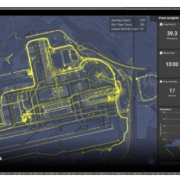
Emu’s platform visualises aircraft, vehicle movements, stand status, taxiway use and other operational data on a dynamic map, allowing teams to monitor activity in real time or replay events to analyse how disruptions developed.

The combined system is designed to help operations teams interpret how events unfold across the airport, rather than relying on fragmented data points. This includes understanding how delays, stand conflicts, or weather conditions affect different parts of operations.

By combining predictive data with real-time spatial insight, the platform aims to support earlier identification of bottlenecks and more coordinated responses.

“We’re giving operations teams a clearer, shared view of their environment that connects predictions, constraints and real-time activity,” explained James Williamson, CEO of Veovo.