

Tag Archive for: Airport Automation

AI assistants handle 13,600 enquiries at San José

San José Mineta International Airport has recorded more than 13,600 passenger conversations with AI-powered virtual assistants since their introduction earlier this year, with the technology resolving approximately 95 percent of questions and achieving an average user rating of 4.6 out of five.

The figures were disclosed by Palo Alto-based AI technology company LiveX, which has launched its AI City platform to provide multilingual assistance, interactive navigation and real-time information across airports and other public venues.

Unveiled at Smart City Expo World Congress in Barcelona, the platform builds on existing deployments at San José, where AI Hosts were initially introduced during Super Bowl LX to help passengers navigate the airport alongside AI-powered holograms of the mayor, Matt Mahan (pictured), and local sports figures.

The assistants have remained in service in Terminal A and at Gate 24 in Terminal B, allowing passengers to request directions verbally, access interactive maps and transfer routes to their phones using QR codes.

Jia Li, Co-founder, President and Chief AI Officer at LiveX, told the Airports AI Alliance that the technology is designed to address the challenges of navigating unfamiliar environments, particularly during periods of heavy passenger traffic.

Jia Li, Co-founder, President and Chief AI Officer at LiveX

“Instead of hunting for an information desk or scanning a static map, visitors can simply walk up and ask, in their own language, with no app or download required,” she said.

According to Li, passenger sessions increased by 74 percent during the 2026 World Cup compared with the preceding period, demonstrating the system’s ability to accommodate higher demand. The deployment has also provided lessons about where assistants should be positioned within terminals.

“Placement matters: Hosts in gate areas, where travellers have time to spare, see far more engagement than those on busy walkways,” Li said.

At San José, the assistant positioned near Gate 24 attracts approximately twice the engagement of one located along a walkway. The technology uses airport-controlled information and NVIDIA retrieval systems to generate relevant responses, while proprietary noise-management technology helps isolate passengers’ voices from background announcements and crowd noise.

“The biggest lesson is that conversation has to work in the real world, not just in a quiet demo room,” Li said.

LiveX has also introduced interactive 3D navigation capabilities, designed to provide more detailed guidance through terminals, and is preparing to deploy Portal, a smaller wall- or stand-mounted device that could extend AI assistance to additional airport locations.

The company says the technology can support routine passenger enquiries while allowing airport staff to focus on more complex requests.

IATA: Digital travel credentials could transform journeys by 2030

The International Air Transport Association (IATA) has warned that fragmented technology systems and inconsistent government requirements are limiting the benefits of artificial intelligence (AI), biometrics and digital identity across the passenger journey. Despite growing adoption, many systems remain confined to individual airports or countries, preventing passengers from experiencing a fully connected journey.

The warning comes as IATA’s 2026 Global Passenger Survey reveals growing demand for digital services. Almost half (49 percent) of passengers have used AI for travel planning, while 58 percent have experienced biometrics during an airport journey in the past year, up from 50 percent in 2025.

During a media briefing on the survey, joined by the Airports AI Alliance, Nick Careen, IATA Senior Vice President, Operations, Safety and Security, said the industry needed to move beyond isolated deployments.

Nick Careen, IATA Senior Vice President, Operations, Safety and Security

“What we need now, however, is for these things to be interoperable and harmonised,” he said. “Once we get to that point, we will have improved services. We will get the efficiencies we’re looking for. We will have improved security.”

First One ID certifications

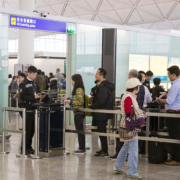
In a significant step towards greater interoperability, Air New Zealand and Hong Kong International Airport (HKIA) have become the first organisations to achieve IATA One ID Certification. The certification assesses compliance with global standards covering digital identity, contactless travel, biometric handling and privacy governance.

HKIA’s Flight Token biometric identification system has been used by more than 93 million passengers since its introduction in 2021, while more than 80 percent of departing passengers are eligible to use facial recognition across all departure checkpoints.

The milestone comes amid growing public acceptance of biometrics. IATA found that 78 percent of passengers would share biometric information to avoid repeated document checks, although 59 percent remain concerned about data breaches.

Jeremy O’Brien, Chief Customer & Digital Officer, Air New Zealand, said the airline’s trial with HKIA demonstrated the potential for cross-border digital identity.

“Our trial with Hong Kong International Airport showed how digital identity could work across borders, reducing the need for documentation and queuing, but it also showed that customers can trust us to keep their information safe,” he said.

Government barriers

Despite technological progress, Careen identified government regulation and inconsistent immigration processes as major obstacles to delivering seamless international journeys. He described his own experiences of online visa applications, including problems with photograph specifications, incompatible files and systems freezing midway through applications.

“They needed to know what I had for breakfast 10 years ago, but you know what? What really worked consistently in all cases is the payment,” he said.

The survey found that 43 percent of passengers had been discouraged from visiting a destination because of immigration requirements, compared with 33 percent in 2025. Careen said the technology needed to address these problems already existed, but governments had to adopt consistent standards.

“So eVisa is the answer, but what it takes is standardisation and consistency. We have it in over 100 countries right now, but too many variations,” he said.

Asked when passengers could realistically expect an internationally interoperable digital journey, Careen suggested meaningful adoption could emerge between now and 2030, with Europe potentially leading through digital travel credentials. IATA has conducted several cross-border proofs of concept, but regulatory restrictions and privacy concerns continue to prevent widespread deployment.

Careen said the trials had demonstrated that digital identity could work between countries, but government regulations still needed to change to allow wider implementation. He also identified data privacy as an obstacle, estimating that meaningful, consistent use of digital travel credentials across international borders could emerge within the next three to five years.

Main image: Valentin M Armianu | Dreamstime.com