Tag Archive for: AI

Continuous data and AI trust, not periodic compliance

Riyadh Air is building its data and AI foundations alongside the airline itself, with governance, accountability and regulatory requirements embedded from the outset. Its approach moves beyond periodic compliance exercises towards a model in which governance and evidence form part of day-to-day operations.

In this case study, Data Sentinel explores how Riyadh Air is establishing a continuous Data and AI Trust foundation to support compliance with Saudi Arabia’s National Data Management Office (NDMO) framework and Personal Data Protection Law (PDPL), while preparing for AI adoption across the airline. It outlines the operating model, phased implementation and technology architecture being used to bring data governance, quality, AI governance and audit evidence together.

What you’ll learn

  • Why Riyadh Air established governance authority and accountability before developing policies.
  • How starting with one division can provide a model for scaling governance across an organisation.
  • Why AI governance is being developed alongside, rather than after, the wider data governance programme.
  • How Riyadh Air’s Trust Layer connects data discovery, classification and audit evidence with controls governing access to AI systems.
  • How continuous governance can support regulatory compliance and AI adoption as the airline scales.


 

Tag Archive for: AI

Vienna Airport expands use of AI assistant to local business district

Vienna Airport is testing its new AI-powered digital assistant at Vienna AirportCity, expanding the technology beyond the airport terminal into its wider business district.

Vienna AirportCity brings together offices, logistics facilities, hotels, restaurants, conference facilities and other services adjacent to the terminal. More than 250 companies are based at the site, with around 23,000 people working across the AirportCity community.

As part of the proof of concept, QR codes have been installed at three locations across the district. Scanning a code opens Hubway.ai’s digital assistant on a user’s smartphone, with the location embedded in the QR code allowing the AI agent to understand where the visitor is starting from and provide directions accordingly.

Visitors can also ask questions about businesses, restaurants, parking, shops and other services at the site. The system is intended to make wayfinding and information easier to access for passengers, employees and other visitors without requiring a dedicated app.

The trial will also allow Vienna Airport to understand which information visitors most frequently look for and the questions they ask. According to AirportCity, these insights will be used to inform the development of its digital services, signage and information provision.


Photo by Palumpawump on Unsplash

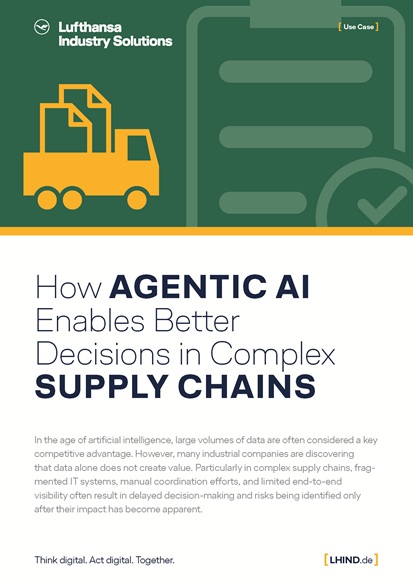
How agentic AI can connect operational data

Organisations are generating more operational data than ever but turning that information into timely decisions remains difficult when it is distributed across multiple systems.

But according to a new use case from Lufthansa Industry Solutions, agentic AI could provide a way to bridge these silos without requiring organisations to replace their existing technology infrastructure.

In How Agentic AI Enables Better Decisions in Complex Supply Chains, Lufthansa Industry Solutions proposes using an AI agent as an orchestration layer across ERP, logistics, IoT and business intelligence systems, allowing employees to interrogate information through natural language and receive contextualised analysis and recommended actions.

“Agentic AI becomes real when it moves from answering questions to getting work done,” said Dr. Stanislaw Schmal, Director Data & AI at Lufthansa Industry Solutions. “Whether coordinating maintenance activities, handling customer requests, or managing operational disruptions, AI agents are already helping organizations improve speed, consistency, and productivity.”

In a supply-chain environment, applications could include identifying material shortages earlier, assessing alternative transport routes, optimising inventory and simulating different scenarios. The broader principle is to connect information already held across an organisation, allowing relationships and emerging risks to be identified without the same level of manual data gathering and analysis.

However, moving towards AI agents that play a greater role in operational decision-making also raises questions around trust and accountability. Schmal emphasises there must be integration with existing business rules, governance mechanisms and role-based authorisation models.

“Trust is not built by the AI itself. It is built through clear governance, human oversight, and measurable results,” Schmal said. “My simple rule: if an AI agent can consistently improve a KPI such as turnaround time, response time, cost, or productivity while remaining transparent and auditable, organizations will trust it with more responsibility.

“The future of agentic AI is not pure autonomous decision-making. It is accountable decision-making at scale.”


Photo by Dennis Gecaj on Unsplash

Paris-Beauvais Airport extends use of conversational assistant

Paris-Beauvais Airport has extended its partnership with conversational AI provider Hubway to 2029 following a six-month pilot that demonstrated strong passenger adoption and engagement.

The solution provides multilingual assistance before and during the airport journey, helping travellers access flight information, wayfinding, transport options, baggage guidance and airport services through a QR code, without requiring an app download.

According to the airport, the trial recorded nearly 4,400 conversations across five locations, achieving a 97 percent resolution rate.  It has supported 36 languages and received an average satisfaction score of almost 4.5 out of 5. The platform also generated significant engagement with airport services, including transport, retail and dining.

Xavier Watel, Head of Customer Experience at Paris-Beauvais Airport, said the airport’s ambition is to offer “an ever smoother, more accessible, and more personalized experience,” adding that the initial results show “conversational intelligence meets a real expectation among our passengers.”

The extended partnership will be delivered in phases over the next three years. Planned developments include expanding the assistant beyond the airport through digital channels, introducing more personalised services and booking capabilities, and creating a multi-channel experience with services available in around 100 languages.

Baggage mishandling falls to record low

Airlines reduced baggage mishandling to its lowest level on record in 2025, according to SITA’s latest Baggage IT Insights report. The global rate fell to 4.9 mishandled bags per 1,000 passengers – down 23 percent year on year – despite continued growth in passenger traffic.

The report attributes the improvement to wider adoption of digital technologies, including AI-assisted baggage routing, real-time data sharing, biometric bag drop and connected passenger devices. Global passenger numbers reached five billion in 2025, while the total number of mishandled bags fell 19 percent to 24 million.

Despite the progress, baggage mishandling continues to cost the aviation industry an estimated US$6.3 billion annually. SITA estimates the average cost of handling a mishandled bag has risen to US$260, with delayed baggage accounting for around 70 percent of total costs. Transfers remain the leading cause of mishandling, responsible for 39 percent of cases.

“Baggage is shifting from a logistical problem to a digital service,” said Nicole Hogg, Portfolio Director Baggage at SITA. “Passengers expect to know where their bag is at every moment, and they’re increasingly willing to help us track it. The next phase is about bringing the technology we already have to every transfer, every handler and every airport, offering greater visibility and connecting every step of the journey. That’s how the industry earns the trust passengers now expect.”

Looking ahead, the report suggests digital investment will continue to accelerate. Three in four airlines plan to invest in AI over the next two years, while half intend to provide passengers with real-time baggage updates. Industry adoption of baggage tracking under IATA Resolution 753 has also surpassed the 50 percent mark, with full compliance targeted for 2027.


Photo by Jacob Narkiewicz onUnsplash

Tampa airport recognised for AI-powered roadway safety system

Tampa International Airport (TPA) has been named one of 16 global finalists for InnoLead’s 2026 Impact Awards, which recognise organisations delivering measurable innovation across a range of industries.

The airport was recognised for its deployment of an AI- and LiDAR-powered warning system designed to prevent overheight vehicles from entering the airport’s Arrivals and Departures roadways, which is a recurring operational challenge at airports worldwide.

Developed with Sotereon.AI, the Overwatch platform combines five LiDAR sensors with artificial intelligence to detect oversized vehicles before they reach restricted areas. When a vehicle exceeds the height limit, digital signs automatically direct drivers away from the terminal while real-time alerts are sent to airport operations and police teams.

“Overwatch takes data from those sensors and turns it into action,” said Doug Wycoff, TPA’s Director of Digital Technologies & Innovation. “We’ve gone from passive warning signs to a fully managed roadway system that tracks height, volume, and speed.”

According to the airport, the system has detected between 18 and 20 overheight vehicles per day since entering service in April. TPA reported that it has not experienced a single overheight vehicle strike since the deployment went live.

The InnoLead Impact Awards winners were announced on 9 June during the Impact 2026 Conference in Cambridge, Massachusetts.


Photo: Tampa International Airport

Miami Airport to launch airport-wide monitoring hub

Miami International Airport (MIA) has unveiled plans for what it describes as the first airport-wide digital monitoring hub in the United States, bringing together airport operations, emergency response and real-time monitoring in a single facility.

The $33 million facility will feature AI-powered long-range cameras, digital tower technology and an integrated panoramic video wall, providing 360-degree visibility across airside, landside and terminal operations. It will also house representatives from up to 30 agencies, enabling faster coordination during operational disruptions and emergency situations.

Miami-Dade County Mayor Daniella Levine Cava said the project builds on the airport’s existing operational model. “In addition to ranking among the busiest airports in the world, MIA is also a proven industry leader in multi-agency collaboration, integrated airport operations, and incident management,” she said.

The facility is designed to transition seamlessly into an emergency operations centre when required, supported by hurricane-resistant infrastructure, cyber-secure architecture and vibration-controlled platforms.

The new Airport Operations Center forms part of MIA’s $14 billion Modernization in Action programme and is scheduled to open in 2027.


Photo by Ronny Rondon on Unsplash

BCG study highlights AI knowledge gap at board level

A new study from Boston Consulting Group (BCG) suggests that while AI is becoming a strategic priority across industries, gaps remain between CEOs and boards in understanding how the technology will reshape business operations and growth.

The global survey of 625 CEOs and board members found that nearly 40 percent of CEOs believe their boards lack “an informed view of how AI is reshaping growth strategy”. At the same time, 75 percent of board members said their AI knowledge is on a par with or ahead of peers.

The findings highlight a broader challenge as organisations move from AI experimentation to operational deployment, placing greater emphasis on governance, oversight and leadership understanding.

Julie Bedard, Managing Director and Partner at BCG, said stronger collaboration between executives and boards will be essential.

“A powerful way for CEOs to bridge the gap between their AI knowledge and their boards’—especially if they feel there is a deficit there—is for the CEO to personally lead an AI upskilling session for their board to show them the latest AI tools and what they can do,” she said.

“CEOs can also bridge the gap by talking about AI in a much more differentiated way to clearly illustrate where AI can be a substitute for humans and where it can complement human work.”

The study also found broad consensus on the importance of AI literacy, with around 80 percent of respondents saying future board members should demonstrate measurable understanding of AI’s industry impact.


Photo by Benjamin Child on Unsplash

New survey shows travellers are open to AI assistance

New research from Amadeus suggests travellers are becoming increasingly comfortable with AI tools to support transport and mobility journeys, especially where technology can reduce friction and improve access to real-time information.

The research highlights that travellers are more willing to share personal data when there is a clear operational benefit, such as faster journeys or improved disruption management.

The study, based on responses from 3,000 global travellers, found that 68 percent would be likely to use an AI-powered travel assistant to suggest and book transport services.

The findings reflect growing demand for more connected travel experiences across different transport modes, with passengers increasingly expecting accurate updates, simplified booking processes and better support during disruptions.

“AI is reshaping traveller expectations faster than any other trend, especially in mobility,” said Peter Altmann, Vice President Mobility and Travel Protection at Amadeus. “Throughout the entire trip, hyper-personalisation and real-time accuracy are now essential. Every recommendation, every update, every booking must be tailored and intuitive.”

Respondents showed the strongest interest in AI applications that support real-time rerouting, multimodal trip coordination and proactive notifications during delays or operational disruptions. More than 80 percent said they value AI-driven recommendations before and during trips.


Photo by Artur Tumasjan on Unsplash

Miami airport rolls out geo-aware AI across operations

Miami International Airport (MIA) has launched a large-scale deployment of geo-aware, agentic AI, introducing a new operational intelligence layer across the airport.

The ‘MIA Virtual Assistant’, developed with Mappedin alongside Satisfi Labs and Hypervsn, delivers real-time, location-based guidance across web, mobile, kiosks and holographic interfaces.

Rather than building a new platform from scratch, MIA focused on integrating existing systems into a single data environment capable of supporting AI at scale.

“We recognised early that the key to deploying geo-aware AI was not waiting for a fully built enterprise common data environment but having the insight to unify the digital strengths we already had and the operational capacity to evolve them into a fully integrated spatial intelligence ecosystem,” an MIA spokesperson told the Airports AI Alliance.

The approach draws on operational data including security checkpoint wait times, gate information and parking to support real-time, location-aware responses.

The rollout addresses limitations in previous wayfinding systems, which relied on downloadable apps and physical infrastructure.

“Our legacy wayfinding approach built around a downloadable app and beacon-based navigation was creating friction for travellers and limiting adoption,” the spokesperson added. “The system worked within its constraints, but it required passengers to install an app, depended on physical hardware, and could not adapt guidance based on real time conditions.”

The new system provides consistent information across channels without requiring downloads. Passenger interactions and movement patterns are captured as part of the platform, providing a view of demand and behaviour across the terminal.

“For airport operations, the questions travellers ask, the requests they make, and the movement patterns the platform observes create a cumulative view of the questions and behaviours that matter most,” they said. “Over time, these interactions reveal where travellers struggle, which areas generate the most inquiries, and where bottlenecks tend to form.”

The system runs within MIA’s Microsoft Azure environment, with governance, data control and security managed through existing airport IT frameworks.

“Airports have become complex ecosystems, and geo intelligence is a new layer of the digital infrastructure,” said Yuval Kossovsky, Managing Director of Transportation at Mappedin. “With Mappedin, we’re transforming indoor mapping from a static reference tool into a living system that perceives, reasons, and acts. Miami International Airport is showing the industry what’s possible.”

Schiphol: scaling AI across airport operations

Airports are increasingly turning to artificial intelligence to manage growing operational complexity – but scaling these systems across a live airport environment requires more than isolated pilots.

Lennert l’Amie, CIO, Royal Schiphol Group

A new case study from Royal Schiphol Group, featured in the recently released Airports AI Alliance Playbook, examines how Schiphol Airport is embedding AI across operations, workforce management and infrastructure planning to sustain growth despite physical capacity constraints.

With passenger volumes rising beyond the terminal’s original design capacity, Schiphol has positioned AI as a core operational capability rather than a technology experiment. Its strategy focuses on three areas: improving operational efficiency, supporting workforce productivity and strengthening capital investment planning.

Operational AI use cases already support aircraft turnaround monitoring and gate planning, combining computer vision and predictive analytics to provide planners with real-time decision support. Newer applications are also addressing workforce conditions, including models that forecast airside air quality and guide safety measures for ground staff.

Governance plays a central role. An internal AI Board brings together legal, privacy and technology leaders to review deployments and manage risk as adoption expands.

Annemijn Schoenmaker, Head of Business Platform Infrastructure, Royal Schiphol Group

“It takes a lot of effort and quite a bit of courage to discuss with your director of security operations that we shouldn’t replace our security lanes because the data says it is not needed,” said Lennert l’Amie, Chief Information Officer of Royal Schiphol Group.

The case study highlights how Schiphol is moving beyond individual AI applications towards a broader ecosystem approach – using data and intelligence to support capacity management, workforce wellbeing and long-term infrastructure planning.

“We’ve proven that technology keeps Schiphol alive,” said Annemijn Schoenmaker, Head of Business Platform Infrastructure at Royal Schiphol Group. “But now we must prove it can keep us evolving.”

Download the case study for free here.


Become a member of the Airports AI Alliance now to receive access to the complete Playbook.


Photo by Rita Candeias on Unsplash