
Tag Archive for: AI in airports

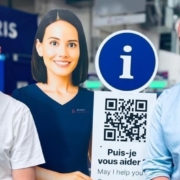
Paris-Beauvais Airport extends use of conversational assistant

Paris-Beauvais Airport has extended its partnership with conversational AI provider Hubway to 2029 following a six-month pilot that demonstrated strong passenger adoption and engagement.

The solution provides multilingual assistance before and during the airport journey, helping travellers access flight information, wayfinding, transport options, baggage guidance and airport services through a QR code, without requiring an app download.

According to the airport, the trial recorded nearly 4,400 conversations across five locations, achieving a 97 percent resolution rate.  It has supported 36 languages and received an average satisfaction score of almost 4.5 out of 5. The platform also generated significant engagement with airport services, including transport, retail and dining.

Xavier Watel, Head of Customer Experience at Paris-Beauvais Airport, said the airport’s ambition is to offer “an ever smoother, more accessible, and more personalized experience,” adding that the initial results show “conversational intelligence meets a real expectation among our passengers.”

The extended partnership will be delivered in phases over the next three years. Planned developments include expanding the assistant beyond the airport through digital channels, introducing more personalised services and booking capabilities, and creating a multi-channel experience with services available in around 100 languages.

Zensors assists TSA on new standard for security wait times

The Transportation Security Administration (TSA) has introduced a new standard for reporting real-time security checkpoint wait times, with Zensors providing the AI-powered platform supporting the initiative.

The system uses computer vision and artificial intelligence to transform existing security cameras into intelligent sensors, enabling continuous measurement of passenger throughput, queue lengths, bag screening times and search rates. According to Zensors, the platform provides TSA and airport operators with a live view of checkpoint performance, replacing manual wait time estimates with automated, real-time insights.

The platform also provides operational guidance, including when to open or close screening lanes and reallocate TSA officers and airport staff, or when to direct passengers towards less congested checkpoints.

Boston Logan International Airport is the first airport to implement the new standard across all security checkpoints, allowing passengers to access official TSA Real Time Wait Time information generated by the platform.

Anuraag Jain, CEO of Zensors, said: “By turning existing security cameras into intelligent sensors, we can deliver real-time operational awareness without requiring new infrastructure, enabling airports and TSA to improve both security operations and passenger experience.”


Foto de Icarus Chu en Unsplash

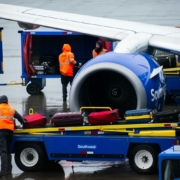
Baggage mishandling falls to record low

Airlines reduced baggage mishandling to its lowest level on record in 2025, according to SITA’s latest Baggage IT Insights report. The global rate fell to 4.9 mishandled bags per 1,000 passengers – down 23 percent year on year – despite continued growth in passenger traffic.

The report attributes the improvement to wider adoption of digital technologies, including AI-assisted baggage routing, real-time data sharing, biometric bag drop and connected passenger devices. Global passenger numbers reached five billion in 2025, while the total number of mishandled bags fell 19 percent to 24 million.

Despite the progress, baggage mishandling continues to cost the aviation industry an estimated US$6.3 billion annually. SITA estimates the average cost of handling a mishandled bag has risen to US$260, with delayed baggage accounting for around 70 percent of total costs. Transfers remain the leading cause of mishandling, responsible for 39 percent of cases.

“Baggage is shifting from a logistical problem to a digital service,” said Nicole Hogg, Portfolio Director Baggage at SITA. “Passengers expect to know where their bag is at every moment, and they’re increasingly willing to help us track it. The next phase is about bringing the technology we already have to every transfer, every handler and every airport, offering greater visibility and connecting every step of the journey. That’s how the industry earns the trust passengers now expect.”

Looking ahead, the report suggests digital investment will continue to accelerate. Three in four airlines plan to invest in AI over the next two years, while half intend to provide passengers with real-time baggage updates. Industry adoption of baggage tracking under IATA Resolution 753 has also surpassed the 50 percent mark, with full compliance targeted for 2027.


Photo by Jacob Narkiewicz onUnsplash

New survey shows travellers are open to AI assistance

New research from Amadeus suggests travellers are becoming increasingly comfortable with AI tools to support transport and mobility journeys, especially where technology can reduce friction and improve access to real-time information.

The research highlights that travellers are more willing to share personal data when there is a clear operational benefit, such as faster journeys or improved disruption management.

The study, based on responses from 3,000 global travellers, found that 68 percent would be likely to use an AI-powered travel assistant to suggest and book transport services.

The findings reflect growing demand for more connected travel experiences across different transport modes, with passengers increasingly expecting accurate updates, simplified booking processes and better support during disruptions.

“AI is reshaping traveller expectations faster than any other trend, especially in mobility,” said Peter Altmann, Vice President Mobility and Travel Protection at Amadeus. “Throughout the entire trip, hyper-personalisation and real-time accuracy are now essential. Every recommendation, every update, every booking must be tailored and intuitive.”

Respondents showed the strongest interest in AI applications that support real-time rerouting, multimodal trip coordination and proactive notifications during delays or operational disruptions. More than 80 percent said they value AI-driven recommendations before and during trips.


Photo by Artur Tumasjan on Unsplash